Skid steer sizes are sorted by one number: rated operating capacity, or ROC, the weight the machine can safely carry in its bucket. Everything else follows from it. A bigger ROC means a heavier, wider machine with more horsepower and more hydraulic flow, a bigger trailer to haul it, and a higher price. Buy too small and you fight the machine all day. Buy too big and it won’t fit through the gate.
This guide lays out the small, medium and large frame classes with the current models from Bobcat, John Deere, Cat, Kubota, Case and New Holland, every figure taken from the manufacturer’s own spec page or sheet. Then it covers how to pick a size for your work, your trailer and your access, and which sizes Pennsylvania dealers had for sale on Heavy Listing on November 12, 2026.
Skid steer size chart: the three frame classes
No standard body defines “small frame” or “large frame.” Bobcat’s buyer’s guide names mini, small, medium and large frames without giving numbers, and the other five makers don’t define them either. The cutoffs below are the ones the trade and rental yards use, and they line up well with how the manufacturers price and market their lineups. The ranges come from the current models listed further down.
| Class | ROC (rated operating capacity) | Operating weight | Engine (gross hp) | Width over tires |
|---|---|---|---|---|
| Mini / stand-on (plus the extra-small Bobcat S70) | About 760 to 1,000 lb | About 2,900 to 3,400 lb | About 23 to 25 hp | About 35 to 36 in |
| Small frame | Under 1,750 lb (1,370 to 1,600 lb in current models) | 5,370 to 5,849 lb | 49 to 67 hp | 58.6 to 59.8 in |
| Medium frame | 1,750 to 2,200 lb | About 6,200 to 7,500 lb | 60 to 74 hp | 59 to 69 in |
| Large frame | Over 2,200 lb (up to about 4,000 lb) | About 7,400 to 10,800 lb | 74 to 121 hp | 66 to 76 in |
Ranges built from the manufacturer figures in the tables below. Class cutoffs are an industry convention, not a manufacturer or SAE definition. Sources: Bobcat buyer’s guide and the spec pages linked under each table.
The chart hides two things. The classes overlap at the edges: Cat’s 246D3 is rated at exactly 2,200 lb and Case’s SR175B at exactly 1,750 lb, so you will see each of them put in either neighboring class, depending on who is talking.
And horsepower does not track ROC neatly. Cat’s small 226D3 has 67.1 gross hp, more than some medium machines, while Bobcat’s small S450 has 49 hp. Size by ROC first, then check the engine.
Skid steer sizes by brand: current lineups
Each brand’s current North American skid steers, sorted into the three classes. The number next to each model is its ROC in pounds at 50% of tipping load, from the maker’s site.
| Brand | Small (under 1,750 lb) | Medium (1,750 to 2,200 lb) | Large (over 2,200 lb) |
|---|---|---|---|
| Bobcat | S450 (1,370) | S590 (2,000) | S64-2 (2,300), S66-2 (2,400), S650 (2,690), S76-2 (2,900), S770 (3,350), S86-2 (3,500) |
| John Deere | None below 1,750 | 316 P-Tier (1,750), 318 P-Tier (1,945), 320G (2,190) | 324G (2,690), 330 P-Tier (2,950), 334 P-Tier (4,000) |
| Cat | 226D3 (1,550) | 236D3 (1,800), 232D3 (1,900), 242D3 and 246D3 (2,200) | 250 (2,689), 262D3 (2,700), 260 (3,160), 270 (3,557), 270 XE (4,015) |
| Kubota | None | SSV65 (1,951) | SSV75 (2,690) |
| Case | SR160B (1,600) | SR175B (1,750), SV185B (1,850), SR210B (2,100) | SR240B (2,400), SR270B (2,700), SV280B (2,800), SV340B (3,400) |
| New Holland | L316 (1,600) | L318 (1,800), L320 (2,000) | L328 (2,800), L334 (3,400) |
Sources: Bobcat skid steer lineup, John Deere fleet sheet (May 2025), Cat skid steer product listing, Kubota SSV series, Case B Series, New Holland skid steers. Bobcat also sells the S70 (760 lb), below its small frames. Kubota’s ROC is half of the published tipping load.
Bobcat, Cat, Case and New Holland cover all three classes. Kubota builds only two wheeled skid steers, one medium and one large. John Deere starts right at the 1,750 lb boundary and has no true small frame skid steer. Count the models and the weight of every lineup sits in the medium and large classes. The used market follows: in the Pennsylvania listings further down, 9 of the 11 machines we could classify are medium or large.
Representative specs for each size
The chart above gives the ranges. This table puts real machines side by side, so you can see how weight, power and width climb with ROC.
| Model | Class | ROC | Tipping load | Operating weight | Engine | Width | Lift path |
|---|---|---|---|---|---|---|---|
| Bobcat S450 | Small | 1,370 lb | 2,740 lb | 5,370 lb | 49 hp | 58.6 in | Radial |
| Cat 226D3 | Small | 1,550 lb | 3,100 lb | 5,849 lb | 67.1 hp gross | 58.9 in | Radial |
| Case SR160B | Small | 1,600 lb | 3,200 lb | 5,645 lb | 60 hp gross | 59.8 in | Radial |
| John Deere 318G | Medium | 1,945 lb | 3,890 lb | 6,542 lb | 65 hp gross | 62.9 in | Vertical |
| Kubota SSV65 | Medium | 1,951 lb | 3,900 lb | 6,790 lb | 60.4 hp gross | 66.5 in | Vertical |
| Bobcat S590 | Medium | 2,000 lb | 4,000 lb | 6,649 lb | 68 hp | 64.7 in | Vertical |
| New Holland L320 | Medium | 2,000 lb | 4,000 lb | 6,470 lb | 67 hp gross | 69.1 in | Vertical |
| John Deere 320G | Medium | 2,190 lb | 4,380 lb | 7,150 lb | 69 hp gross | 67.0 in | Vertical |
| Bobcat S650 | Large | 2,690 lb | 5,380 lb | 7,901 lb | 74 hp | 72.1 in | Vertical |
| Cat 262D3 | Large | 2,700 lb | 5,400 lb | 8,296 lb | 74.3 hp gross | 66 in | Vertical |
| Case SV340B | Large | 3,400 lb | 6,800 lb | 9,100 lb | 90 hp gross | 73.8 in | Vertical |
| Bobcat S86-2 | Large | 3,500 lb | 7,000 lb | 10,098 lb | 115 hp | 72 in | Vertical |
| Cat 270 XE | Large | 4,015 lb | 8,029 lb | 10,847 lb | 121 hp gross | 72 in | Vertical |
Sources: Bobcat S450, S590, S650, S86-2; Cat 226D3, Cat 262D3, Cat 270 XE; John Deere 318G and 320G spec sheets; Kubota SSV series; Case SV340B, Case SR160B; New Holland L320. Bobcat does not say gross or net on its hp figures. Width is without a bucket (Deere, Bobcat) or over the tires (Cat, Case, Kubota, New Holland). Deere’s 318G sheet gives base weight; Kubota’s 2026 brochure lists the SSV65 at 6,790 lb with an open cab and 7,055 lb with a closed cab, operator included.
Going from small to medium adds roughly 1,000 to 1,300 lb of machine and up to about 10 inches of width. Going from a medium frame to the top of the large class adds another 1,500 lb or more of ROC and 3,000 to 4,000 lb of weight. That extra weight comes with a bigger trailer and a higher price, so don’t buy it unless the work needs it.
Every small frame in this table is radial lift and every medium and large one is vertical. That is a trend, not a rule: Case still sells large radial machines like the SR240B and SR270B, and Cat’s 246D3 is a radial machine right at the 2,200 lb line. Our guide to radial vs vertical lift skid steers explains what the lift path changes.
Skid steer ROC vs tipping load: what the rating really means
Tipping load is the weight in the bucket that lifts the rear of the machine off the ground. ROC is a safety margin below that. In Bobcat’s words, ROC is typically 50% of the tipping load for skid steers and 35% for compact track loaders. Every wheeled model in the tables above follows the 50% rule exactly: the Case SV340B is rated at 3,400 lb against a 6,800 lb tipping load, and Case prints “Rated Operating Capacity: 50% of Tipping Load” on its spec pages.
What that means when you compare machines:
- Don’t compare a wheeled ROC with a tracked ROC. A track loader rated at the same ROC as a skid steer has a much higher tipping load. Our skid steer vs compact track loader comparison walks through twin models where this matters.
- Counterweights change the class. Bobcat rates the S650 at 2,690 lb, or 2,840 and 2,890 lb with its 200 and 300 lb counterweight kits. Deere’s 320G goes from 2,190 to 2,350 lb with counterweight, which pushes a medium frame into large-frame numbers.
- ROC assumes the bucket the maker tested with. Cat, for example, bases its specs on a named bucket width for each model. Pallet forks, grapples and long attachments move the load forward, so the real safe load with them is lower than the bucket rating. Check the attachment’s own capacity.
Mini loaders muddy the comparison further. Kubota rates its stand-on SCL1000 at 1,000 lb at 35% of tipping load, the track loader convention, while Bobcat rates its MT100 at 1,000 lb to an ISO method. The two spec sheets show the same 1,000 lb, but they were not calculated the same way.
What size skid steer do I need? Match the class to the work
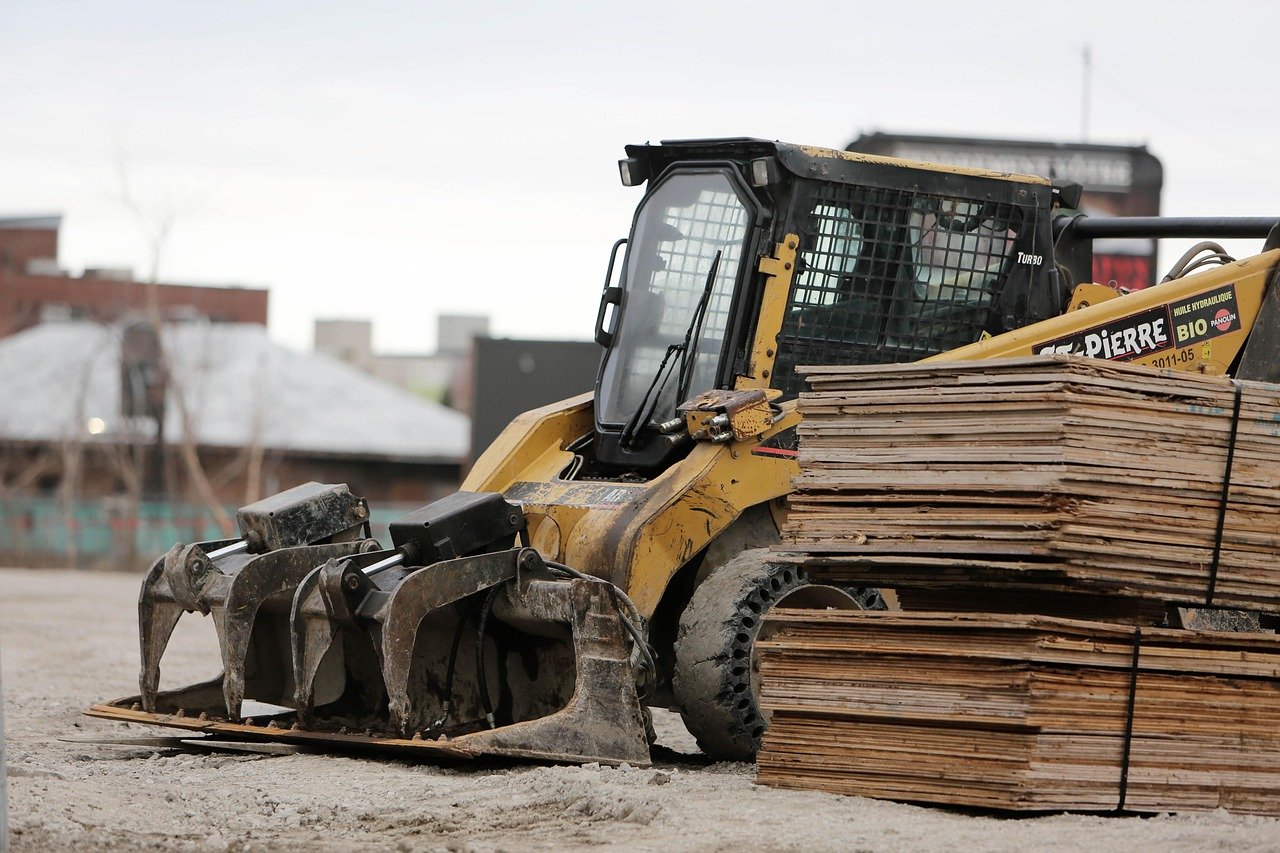
Start with the heaviest thing you will lift often, not the heaviest thing you might lift once a year. Weigh a typical full load of what you handle: a pallet of pavers, a bucket of wet topsoil, a round bale. Keep that under the ROC with some room to spare, then check the other limits.
| Main work | Usual class | Why |
|---|---|---|
| Backyard landscaping, fence lines, work behind houses | Small, or mini / stand-on | Width and weight. A 5-foot machine fits where a 6-foot one cannot, and it is lighter on lawns and driveways. |
| Barn cleaning, livestock, interior demolition | Small or medium | Low doors, tight alleys and short turns favor the smaller frames. |
| General contracting, site cleanup, light grading | Medium | Enough capacity for most materials and attachments, still easy to haul behind a pickup. |
| Snow removal on lots | Medium or large | Weight helps push, and a wider frame carries a wider blade or pusher. |
| Loading trucks, pallets of block and stone, heavy material handling | Large, vertical lift | Higher ROC and more reach at full height. |
| Forestry mulchers, cold planers, big trenchers | Large with high-flow hydraulics | These attachments need flow and horsepower that small frames don’t have. |
❌ Buying by horsepower alone. A small Cat 226D3 has more gross horsepower than a Kubota SSV65, but the Kubota lifts about 400 lb more.
❌ Sizing for the biggest job of the year. If you only load trucks a few times a season, rent a large frame for those days and own the machine that fits the other 300.
✅ Measuring the tightest spot first. Gate, barn door, trailer deck: write the width down before you shop.
✅ Buying one step up when the work is mixed. If you sit right at the line between two classes and attachments are part of the plan, the bigger frame usually pays back in hydraulic flow and stability.
Width and access: will it fit through the gate?
Width over the tires is the number that decides access, and the bucket is usually wider than the machine. Bobcat lists both: the S450 is 58.6 in without a bucket and 62 in with one; the S590 is 64.7 and 68 in; the S650 and S770 are 72.1 and 74 in. Kubota’s SSV75 is 71.8 in over the wheels and 75 in with its standard bucket.
- Mini and stand-on: about 35 to 36 in. Bobcat’s S70 is 35.5 in, the Kubota SCL1000 is 36 in with its standard bucket.
- Small frame skid steers: about 5 feet. The Bobcat S450, Cat 226D3, Case SR160B and New Holland L316 all measure 58.6 to 59.8 in.
- Medium frame: about 5 to 5.75 feet, from the Cat 232D3 at 58.9 in and the John Deere 318G at 62.9 in to the New Holland L320 and Case SR210B at 69.1 in.
- Large frame: from 66 in on the Cat 250 and 262D3 up to 76 in on the New Holland L334.
Measure the opening, not the gate: posts, latches and the swing of the gate itself take inches. Then look at what’s behind it. A machine that squeezes through a gate still needs room to turn, and on finished lawns a lighter machine leaves fewer marks.
If the bucket is the only thing that doesn’t fit, a narrower bucket can fix it. If the tires don’t fit, you need a smaller frame.
Weight, trailer and truck: the size you can actually haul
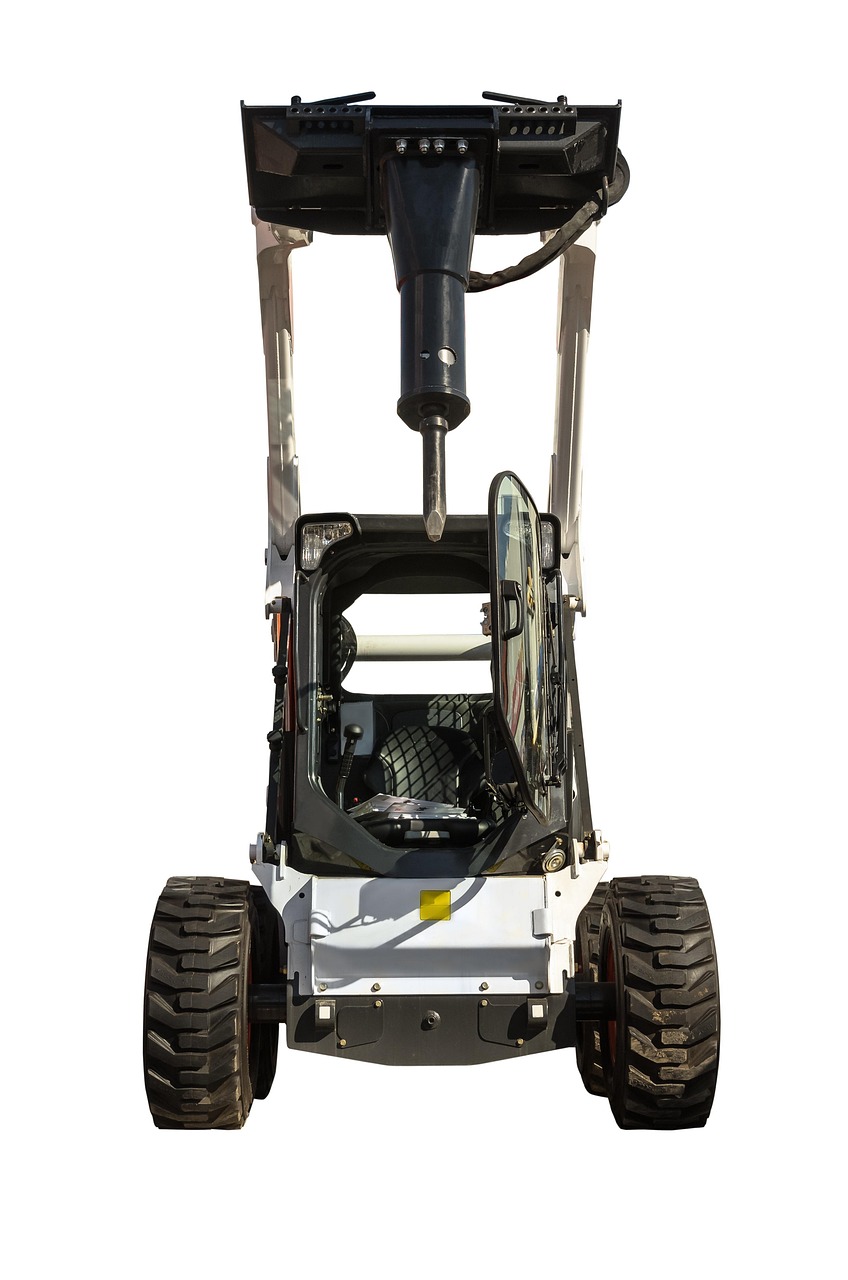
Operating weight sets the trailer. A small frame at 5,370 to 5,850 lb goes on a lighter equipment trailer behind a heavy-duty pickup. The heaviest large frames, at 9,000 to 10,800 lb, plus a bucket, an attachment or two and the trailer itself, puts you into gooseneck territory and close to federal limits.
Two federal thresholds matter for large frames, both in our guide to transporting heavy equipment in Pennsylvania:
- Tie-downs: machinery weighing 10,000 lb or more needs at least four tie-downs under 49 CFR 393.130. The Bobcat S86-2 (10,098 lb) and Cat 270 (10,441 lb) are over that line on their own.
- CDL: a combination with a gross combination weight rating of 26,001 lb or more, towing a trailer rated over 10,000 lb, needs a Class A CDL when used in commerce (49 CFR 383.91). A trailer that carries a large frame is usually rated over 10,000 lb, so check the ratings on both the truck and the trailer.
Spec-sheet weight is only the start: buckets, counterweights, cab enclosures and attachments all add pounds. Our article on how much a skid steer weighs goes model by model.
Attachments and hydraulic flow by size
Size also decides what you can run on the front. Standard auxiliary flow climbs with the frame:
| Model | Class | Standard aux flow | High flow |
|---|---|---|---|
| Bobcat S70 | Extra small | 8.9 gpm | Not listed |
| Bobcat S450 | Small | 16.7 gpm | Not listed |
| Bobcat S590 | Medium | 17.1 gpm | Not listed |
| John Deere 320G | Medium | 21 gpm | 30 gpm |
| John Deere 324G | Large | 21 gpm | 32 gpm |
| Bobcat S650 | Large | 23 gpm | 30.5 gpm |
Sources: Bobcat model pages linked above and S70; John Deere 320G and 324G spec sheets. “Not listed” means the page we read gave no high-flow figure.
Buckets, forks, grapples, augers and light brooms work on any class. The hungry attachments, such as forestry mulchers and cold planers, usually call for a high-flow circuit, which you find as an option on medium and large frames. If one of those is in your plan, read our breakdown of high flow vs standard flow before you settle on a size, and see which skid steer attachments each class can realistically run.
Mini and stand-on loaders: a separate class
Mini track loaders and stand-on loaders are not small skid steers. The operator stands on a platform at the back, the machine is about 3 feet wide, and the ROC is around 1,000 lb. Bobcat’s MT100 weighs 3,390 lb with 24.8 hp; Kubota’s SCL1000 has 23.7 gross hp and a 36 in standard bucket. Bobcat’s S70 sits between the two worlds: a sit-in wheeled skid steer that is only 35.5 in wide and rated at 760 lb.
They make sense for landscapers, irrigation crews and anyone working through 3-foot gates every day. They don’t make sense as a first loader for a farm or a contractor: around 1,000 lb of ROC against 1,370 to 1,600 lb on a current small frame, and much less material per trip.
What sizes are for sale in Pennsylvania right now
On November 12, 2026, Pennsylvania dealers had 22 used wheeled skid steers and 4 mini loaders listed on Heavy Listing. We sorted the skid steers into classes using the manufacturer’s ROC for that model name.
Eleven are older models (Case 1845C and 60XT, John Deere 328 and 320E, New Holland L220, Bobcat 753, S570, S630 and S750) whose specs we could not verify on the makers’ current sites, so we left them unclassified rather than guess.
| Class | Machines | Models listed | Model years | Median asking price |
|---|---|---|---|---|
| Mini / stand-on | 4 | Kubota SCL1000 (2), Bobcat MT55, Vermeer S800TX | 2015 to 2023 | $24,200 |
| Extra small (under small frame) | 1 | Bobcat S70 | 2011 | $14,500 |
| Small | 1 | Bobcat S450 | 2018 | $27,500 |
| Medium | 4 | Bobcat S590 (2), John Deere 318G, John Deere 320G | 2023 to 2025 | $44,450 |
| Large | 5 | Bobcat S650 (3), Bobcat S770, John Deere 332G | 2017 to 2020 | $29,500 |
| Not classified (older models) | 11 | See above | 2001 to 2018 | $19,500 |
Source: Heavy Listing, used skid steers and mini skid steers listed by Pennsylvania dealers on November 12, 2026. John Deere 332G ROC (3,600 lb) from its spec sheet; other ROCs from the current spec pages above. ROC can change slightly between model years.
Yes, the medium machines have a higher median than the large ones. That is age, not size: the four medium frames are 2023 to 2025 models, the large ones 2017 to 2020. On the used market, model year and hours move the price more than frame class does.
The spread inside one model is just as wide. Three Bobcat S650s, all the same large frame, listed at $17,500, $22,500 and $37,500, with 3,371, 6,535 and 422 hours. If your budget says medium but the work says large, a higher-hour large frame is a real option. For more on how age and hours set the price, see our analysis of used skid steer prices from Pennsylvania dealers.
Skid steers listed by dealers on Heavy Listing right now:
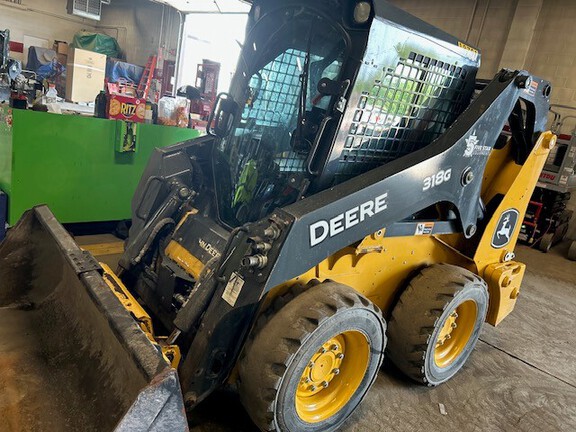
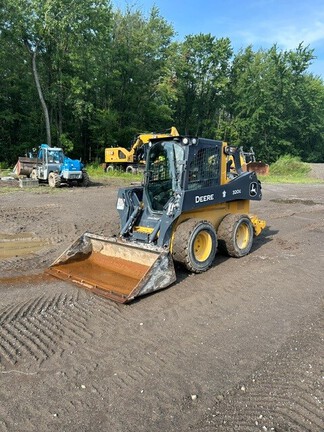
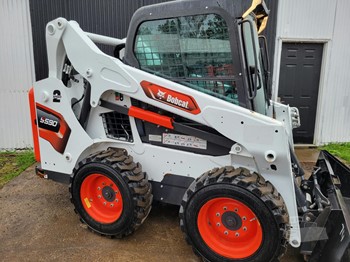
Find your size in stock
Every listing shows the year, hours and asking price. Look up the model in the brand table above to see its class, then call or email the dealer directly.
Browse used skid steers in Pennsylvania →Buying used: size-specific things to check
- Look up the ROC for that exact model and year. Model names carry over between generations, and a counterweight kit or a different tire option changes the rating. The decal on the machine and the operator’s manual are the final word.
- Large frames work harder. High-flow attachments and heavy loading put more strain on hydraulics, drive motors and the loader arm pins. Ask what attachments the machine ran, not just how many hours it has.
- Small frames often lived on rough jobs. Rental fleets and landscapers buy them, so check tires, the bucket’s cutting edge and the quick-attach plate for wear.
- Check the aux hydraulics match your attachments. A large frame without the high-flow option will not run a mulcher, whatever its size.
Our list of common skid steer problems covers what fails most and what each repair tends to involve.
The bottom line on skid steer sizes
Skid steer sizes come down to one number and three checks. Pick the class by ROC, then check that the machine fits your gate, your trailer and your attachments. For most buyers that lands on a medium frame, between 1,750 and 2,200 lb of ROC, about 6,200 to 7,500 lb and 5 to 5.75 feet wide. Go small or mini when access decides everything. Go large when you load trucks, handle heavy pallets or plan to run high-flow attachments, and plan the trailer and the license that come with it. And when you shop used, remember that a newer machine one size down can cost more than an older one a size up.
FAQ
What are the sizes of skid steers?
Skid steers are usually grouped by rated operating capacity (ROC): small frame under 1,750 lb, medium frame from 1,750 to 2,200 lb, and large frame over 2,200 lb. Mini and stand-on loaders, rated around 1,000 lb, are a separate class. These cutoffs are a trade convention; manufacturers don’t publish an official definition.
What size skid steer do I need for a farm or acreage?
Usually a medium frame. It lifts about 1,750 to 2,200 lb, is about 5 to 5.75 feet wide, and can go on a pickup-towed trailer. Go smaller if you work inside low, narrow barns; go larger if you handle heavy bales or load trucks often.
How wide is a skid steer?
Current small frames measure 58.6 to 59.8 in over the tires, medium frames about 59 to 69 in, and large frames 66 to 76 in. The bucket is often a few inches wider than the machine. Mini and stand-on loaders are about 35 to 36 in.
What does ROC mean on a skid steer?
Rated operating capacity, the load the machine can safely carry. On wheeled skid steers it is 50% of the tipping load; on compact track loaders it is typically 35%.
Is a bigger skid steer always better?
No. A larger frame lifts more and runs bigger attachments, but it costs more, needs a heavier trailer, may not fit through gates or barn doors, and is harder on lawns and finished surfaces. Buy the size you need for most of your work.