You bought the machine. Now it has to get from the seller’s yard to your jobsite, and that part catches many first-time buyers off guard. This guide explains how to transport heavy equipment in Pennsylvania: haul it yourself or hire a hauler, which trailer fits which machine, when you need a CDL, the federal tie-down rules, when PennDOT requires an oversize load permit, and what drives the cost. Every rule links to the federal or state page it comes from.
Plan the move before you buy, not after
Auctioneers publish removal deadlines and charge storage when you miss them. In our step-by-step guide to buying at an equipment auction, two Pennsylvania auctioneers gave buyers 14 days and “the second Friday after the sale” to remove their machines, with daily storage fees after that.
So before you bid or sign, get three numbers for the exact machine:
- Operating weight, from the manufacturer’s spec sheet for that model and configuration.
- Width, including tracks, tires or blade, whichever is widest.
- Height as it will sit on the trailer, with the boom or bucket lowered.
Those three numbers decide the trailer, the truck, the license, the number of chains and whether you need a permit. Give them to any hauler you call.
Haul it yourself or hire a hauler?
| Haul it yourself | Hire a hauler | |
|---|---|---|
| Best for | Mini excavators, skid steers, compact track loaders, small backhoes | Excavators, dozers, wheel loaders, anything over legal width or height |
| You need | A truck and trailer rated for the load, chains and binders, the right license | The machine’s specs, the pickup address and a loading window |
| Main risk | Overloading the truck or trailer, weak tie-downs, CDL rules you did not know applied | Choosing on price alone, unclear insurance, missed pickup dates |
| Permits | Your job if the load is oversize | Usually the hauler’s job; confirm it in the quote |
Many dealers can arrange delivery. In our guide to used heavy equipment dealers in PA, Keystone Equipment lists trucking among its services and Old Forge Power Equipment quotes freight online. Ask the dealer before you call around.
If you are buying in Pennsylvania and taking the machine out of state, who arranges the truck matters for tax. Under PA rules, if you or your hauler pick it up in Pennsylvania, PA sales tax applies; if the seller ships it out of state, it does not. Our guide to PA sales tax on heavy equipment walks through the regulation.
Trailer types and what each one typically carries
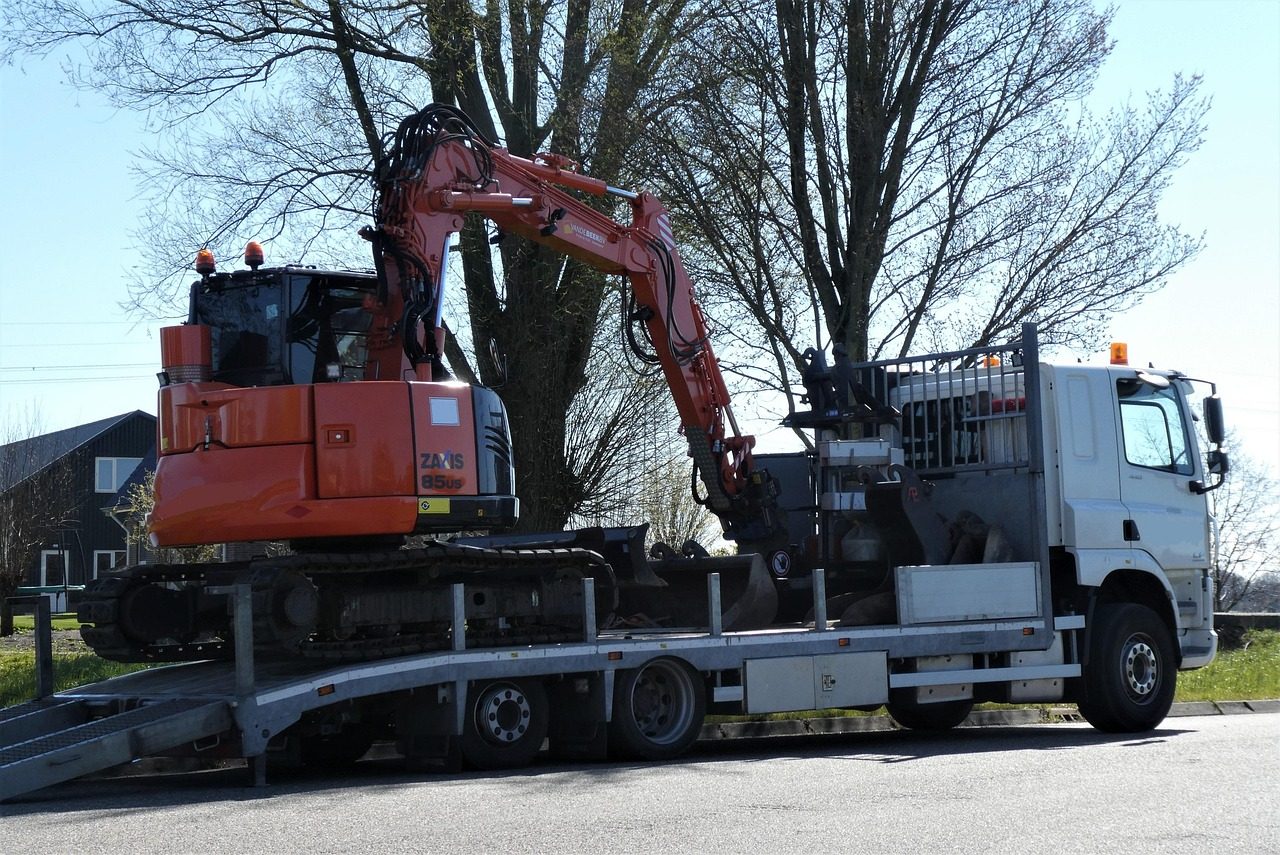
Ratings vary by manufacturer and axles, so this table shows typical use, not capacities. The number that counts is the GVWR on the trailer’s VIN plate.
| Trailer | How it hitches | Typically carries | Watch out for |
|---|---|---|---|
| Tag trailer (bumper-pull) | Ball or pintle hitch on a heavy-duty pickup | Mini excavators, skid steers, smaller track loaders, attachments | Tongue weight and the pickup’s towing rating; the machine must sit forward of the axles |
| Gooseneck | Ball in the pickup bed, over the rear axle | Larger track loaders, backhoes, small dozers and excavators within its rating | Easy to push the combination past 26,001 lb rated, which brings in CDL rules |
| Tilt deck | Bumper-pull, gooseneck or semi, depending on size | Machines with low clearance: skid steers, rollers, lifts, mowers | Check the tilt lock and the pivot point before loading |
| Step deck (drop deck) | Semi tractor | Mid-size machines that are too tall for a flatbed | Usually needs ramps; deck height still limits tall loads |
| Lowboy / RGN (removable gooseneck) | Semi tractor; on an RGN the front detaches so the machine drives on from the front | Excavators, dozers, wheel loaders and tall or heavy machines | Requires a CDL driver; wide machines still need permits |
A low deck is the point of a lowboy: a machine that would be over 13 feet 6 inches on a flatbed can often stay under it, which can save a height permit.
How much do common machines weigh?
These weights come from the manufacturers’ spec sheets and are examples only: booms, counterweights, shoes and buckets change them, so check the sheet for your exact machine.
| Machine | Operating weight (spec sheet) | Usual way to move it |
|---|---|---|
| Bobcat E35 compact excavator | 7,659 lb (Bobcat) | Tag or gooseneck trailer |
| Bobcat T770 compact track loader | 10,515 lb (Bobcat) | Gooseneck trailer |
| John Deere 650K crawler dozer | 21,320 lb (XLT) to 22,343 lb (LGP) base weight (Deere spec sheet) | Heavy gooseneck or semi with lowboy |
| John Deere 544 P-Tier wheel loader | 30,520 to 32,827 lb depending on setup (Deere spec sheet) | Semi with lowboy or step deck |
| John Deere 210 P-Tier excavator | 50,391 to 53,483 lb; 9 ft 10 in to 10 ft 6 in wide over the tracks (Deere spec sheet) | Semi with lowboy, plus an oversize permit |
Two things stand out. The T770 is just over 10,000 lb, so the federal heavy machinery tie-down rule below applies to it. And the 210 excavator is wider than Pennsylvania’s 8 feet 6 inch legal width with any of its track shoes, so it needs a permit before it moves on a public road.
Shopping by size? Our price guides for used excavators and used dozers sort the Pennsylvania listings by weight class, which is also a good way to plan the truck.
Do you need a CDL to haul your own equipment?
Often, yes, and buyers with a big pickup and a gooseneck are the ones who miss it. The federal rule in 49 CFR 383.91 defines the vehicle groups:
- Class A (combination vehicle): a gross combination weight rating (GCWR) of 26,001 lb or more, when the towed vehicle has a GVWR over 10,000 lb.
- Class B (heavy straight vehicle): a single vehicle with a GVWR of 26,001 lb or more, towing no more than 10,000 lb GVWR.
Three details matter here:
- It goes by ratings, not just what is on the scale. The definition in 49 CFR 383.5 uses the rating or the actual weight, whichever is greater. A heavy-duty gooseneck trailer rated over 10,000 lb behind a pickup can put you in Class A territory with a light machine on the deck.
- It covers vehicles used in commerce. Moving a machine for your business can count. If you think an exception applies, such as farm use, confirm it with PennDOT first.
- Other federal rules start lower. For interstate trips, the federal definition of a commercial motor vehicle in 49 CFR 390.5 starts at 10,001 lb, which can bring in other requirements even without a CDL. Crossing into Maryland or Ohio with a pickup and trailer? Check before the trip.
Tie-down rules for heavy equipment
Federal cargo securement rules have a section just for this: 49 CFR 393.130, for heavy vehicles, equipment and machinery on wheels or tracks. It covers machines that individually weigh 10,000 lb or more; lighter ones may be secured under it or under the general rules. It requires:
- Lower and secure attachments. Accessory equipment must be completely lowered and secured to the vehicle: bucket, blade and boom down on the deck.
- Stop articulation. Articulated machines, like wheel loaders, must be restrained so they cannot articulate in transit.
- At least four tie-downs. The machine must be restrained against movement forward, rearward, sideways and up, with a minimum of four tie-downs.
- Use the right points. Each tie-down goes as close as practicable to the front and rear of the machine, or to the tie-down points the manufacturer built for that purpose.
How strong do the chains need to be?
The general rule in 49 CFR 393.106(d) says the combined working load limit (WLL) of the tie-downs must be at least half the weight of the cargo. The catch: a tie-down that runs from the trailer to an anchor point on the machine only counts for half its WLL.
Example with a Bobcat T770 at 10,515 lb:
- Half its weight is about 5,258 lb. That is the minimum aggregate WLL.
- With four chains running directly from the trailer to the machine’s tie-down points, each counts at half its rating. So the four ratings together must add up to at least 10,515 lb, or about 2,630 lb each.
- That is the legal minimum. Check the WLL marked on every chain and binder before you count it.
❌ Wrong: “Two chains over the tracks will hold it. It’s not going anywhere.”
✅ Right: “Four rated chains to the manufacturer’s tie-down points, front and rear, bucket on the deck, and I checked the WLL tags add up.”
Pennsylvania oversize and overweight permits
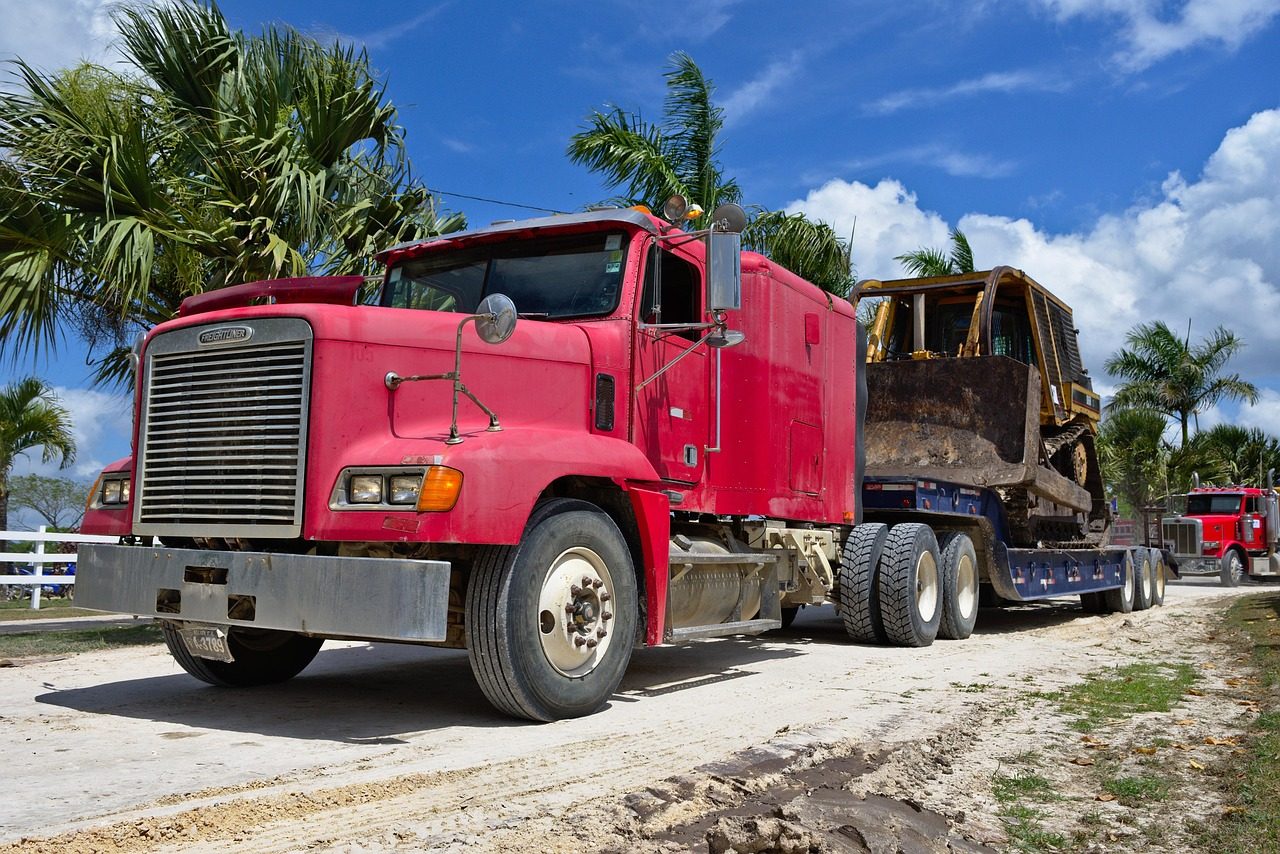
The legal limits
PennDOT’s size and weight limitations page lists the limits a load has to stay within to move without a permit:
| Dimension | Pennsylvania limit |
|---|---|
| Width | 8 feet 6 inches (single vehicle, and truck and truck tractor combinations) |
| Height | 13 feet 6 inches |
| Length | 40 feet for an individual motor vehicle; 53 feet for a single trailer (with the kingpin to rear axle limit) |
| Gross weight | 80,000 lb for any individual vehicle or combination |
Go over any of them with a load that cannot be broken down, and you need a special hauling permit before the trip.
How to get the permit
PennDOT issues hauling permits through its online Automated Permit Routing / Analysis System (APRAS), according to its hauling permit page. Account holders log in and apply online; companies without an APRAS account go through a Permit Service Partner. Fees, application forms and holiday travel restrictions are linked from the same page. The Pennsylvania Turnpike is separate: it issues its own over-dimensional and overweight permits for non-divisible loads through its Special Hauling Permit system.
What a permit comes with
The conditions are in 67 Pa. Code Chapter 179. Unless the permit says otherwise:
- Travel times are restricted. Under § 179.10(7), permitted moves are not authorized from sunset to sunrise, on Saturday after 12 noon, on Sunday, or on listed holidays and the day before them. Urbanized areas have their own time windows.
- Signs and flags. Yellow “OVERSIZE LOAD” signs at least 7 feet wide by 18 inches high go on the front and rear (§ 179.10(15)), and the edges of a wide or long load get red or fluorescent orange flags at least 18 inches square (§ 179.10(16)).
- Pilot cars past 13 feet wide. Over 13 feet total width, a pilot car is required (§ 179.10(13)).
- Dozer blades. A dozer with its blade attached that is over 12 feet but no more than 15 feet wide can be hauled if a traffic protector guide rail device is fastened to it (§ 179.11(c)).
- Super loads. Over 16 feet wide, 160 feet long or 201,000 lb gross is a super load, with its own process (§ 179.1).
The practical takeaway: if the spec sheet says the machine is wider than 8 feet 6 inches, or it will sit taller than 13 feet 6 inches on the trailer, hire a hauler who pulls permits every week, and confirm in writing that the permit is included in the price. If the trip crosses into another state, check that state’s permit rules too.
Heavy equipment hauling in Pennsylvania: what drives the cost
We do not publish per-mile rates: we found no public source we could verify, and quotes swing a lot with the job. Here is what goes into a quote:
- Distance, both ways. A hauler based far from the pickup bills the drive to get there.
- Weight and size. They decide the trailer. A machine that fits on a gooseneck costs less to move than one that needs a semi and lowboy.
- Permits and escorts. Permit fees, route restrictions and pilot cars add cost. Daylight-only, weekday-only travel can turn a one-day move into two.
- Loading. A machine that runs and drives onto the trailer is quick. One that does not start, or needs a forklift, a crane or a loading dock, takes time and equipment.
- Waiting, tolls and timing. Ask how wait time at a busy yard is billed. Oversize routes are not always the shortest. A rush date before an auction removal deadline leaves less room to negotiate.
Get two or three written quotes for the same machine, same dimensions and same dates. Ask each hauler for their USDOT number and a certificate of insurance that covers the cargo, and confirm what the quote includes: permits, escorts, tarping and any loading help.
Find the machine first, then plan the truck
Browse used equipment from Pennsylvania dealers on Heavy Listing. Every listing shows the location, so you can see how far the haul is before you call the dealer.
Browse equipment for sale →Auction pickups: what is different
- Fixed windows. Loading happens only on set days and hours. Book the truck for those, and ask whether the yard loads machines or the hauler does.
- Paid first. Auction yards typically will not release a machine until payment clears. Our auction buying guide lists real payment and removal terms from Pennsylvania sales.
- As-is condition. A machine that sat in a yard may not start. Tell the hauler and plan for a winch or loading help.
Upcoming sales are on our auction calendar, and our guide to equipment auctions in Pennsylvania covers who runs them.
Checklist before the truck leaves
- ☐ Machine’s operating weight, width and height from the spec sheet, sent to the hauler.
- ☐ Trailer GVWR and truck GCWR checked against the load, plus a driver with the right CDL class.
- ☐ Permit in hand if the load is over 8 feet 6 inches wide, 13 feet 6 inches tall, or over the length or weight limits, with the route and travel times on it.
- ☐ At least four rated tie-downs on any machine of 10,000 lb or more, attached at the manufacturer’s tie-down points, with WLL that adds up.
- ☐ Bucket, blade and boom lowered and secured to the deck; articulation lock on.
- ☐ Overall height measured on the trailer, not guessed. Cab doors and windows shut, loose attachments secured.
- ☐ Bill of sale, invoice and release paperwork in the cab.
- ☐ Hauler’s USDOT number and certificate of insurance on file.
The bottom line
How to transport heavy equipment comes down to three numbers from the spec sheet: weight, width and height. They decide pickup and trailer or semi and lowboy, whether the driver needs a Class A CDL, how many chains go on, and whether PennDOT must issue a permit first. Small machines are a fair do-it-yourself job if your truck, trailer and license match the load. Big or wide ones are a job for a hauler who pulls permits every week. Either way, plan the move before you buy and get more than one quote.
Frequently asked questions
Do I need a permit to haul an excavator in Pennsylvania?
Only if the load is over the legal limits: 8 feet 6 inches wide, 13 feet 6 inches tall, the length limits, or 80,000 lb gross. Many mid-size excavators are wider than 8 feet 6 inches over the tracks. A John Deere 210 P-Tier, for example, is 9 feet 10 inches to 10 feet 6 inches wide, so it needs a PennDOT permit.
How many tie-downs does heavy equipment need?
Under 49 CFR 393.130, machines that weigh 10,000 lb or more need at least four tie-downs, placed as close as practicable to the front and rear or at the manufacturer’s tie-down points. The combined working load limit must be at least half the machine’s weight.
How do I get an oversize load permit in PA?
Apply through PennDOT’s online Automated Permit Routing / Analysis System (APRAS), or through a Permit Service Partner if you have no account. The Pennsylvania Turnpike issues its own permits.
Can oversize loads travel at night or on weekends in Pennsylvania?
By default, no. Under 67 Pa. Code § 179.10(7), permitted moves are not authorized from sunset to sunrise, after noon on Saturday, on Sunday or on listed holidays and the day before, unless the permit says otherwise.