Radial vs vertical lift is the skid steer spec that changes how the machine works all day, not just how the brochure reads. It decides where the bucket goes as the arms come up: out in front of the machine at mid height, or almost straight up to the top. Pick the wrong one and you will be fighting it on every truck you load or every trench you backfill.
This guide compares the two with the manufacturers’ own spec sheets for three matched pairs (same engine, same wheelbase or track length, different arms), shows how to tell which one a used machine has, and lists which lift path the skid steers and track loaders for sale from Pennsylvania dealers on Heavy Listing actually have. If you are still deciding on frame size, start with our skid steer size guide and come back.
Radial vs vertical lift skid steer: the short version
| Radial lift | Vertical lift | |
|---|---|---|
| Arm path | An arc around one pivot pin behind the cab | Close to straight up, guided by extra links |
| Most reach | At mid height (arms level with the ground) | At full height |
| Best at | Digging, grading, backfilling, pushing, loading flatbeds, dumping over a wall | Loading high-sided trucks and dumpsters, pallets, lift and carry |
| Rated capacity | Lower than its vertical twin | Higher than its radial twin |
| Moving parts | Fewer pins and bushings | More pins, links and grease points |
| Weight | Lighter | Heavier, by about 360 to 820 lb on the pairs below |
Sources: manufacturer spec sheets cited under each comparison below; grease points from Case TR270B product page.
How a radial lift skid steer works
On a radial lift machine, each lift arm hinges on a single pin at the back of the loader tower. When the arm goes up, the bucket travels in a circle around that pin. Partway up, the arms are level with the ground and the bucket is as far in front of the machine as it will ever be. Past that point the bucket starts swinging back toward the cab, and at full height it sits closer to the front tires than it did at mid height.
Manufacturers describe it the same way. Case says its radial design is “designed for grading, prying, and below grade digging” and gives “further reach at mid-lift height than a vertical lift.” Cat’s spec sheet credits its radial models with “excellent digging performance and superior mid-lift reach.” Bobcat sums it up as “maximum reach at truck bed height.”
The simple geometry also makes radial arms easier to keep up. Case points out that its radial design “has fewer grease points than vertical lift.” On a used machine, fewer pins means fewer places for slop to build up.
How a vertical lift skid steer works
A vertical lift machine adds one or more short links between the lift arm and the frame. As the arm rises, those links move the pivot point, so the bucket travels nearly straight up and ends a little forward at the top. In Case’s words, vertical lift “changes the path from a radial arc to a straight, up-and-down path. This allows for more reach at full extension, as well as offering higher lift capacity and greater stability.”
Two things follow from that path. The load stays closer to the machine through the middle of the lift, which is why vertical machines carry a higher rated operating capacity than a radial twin of the same weight class. And the bucket is out past the side of a truck bed when it gets to the top, so the load lands toward the middle of a high box instead of piling up against the near wall.
Matched pairs: what the spec sheets show
The cleanest way to see what the arms change is to compare twins: same engine, same wheelbase, different lift path. Cat and John Deere both publish full dimension tables that include reach, so these are the numbers we used.
Cat 246D3 (radial) vs Cat 262D3 (vertical)
| Spec | Cat 246D3 radial | Cat 262D3 vertical |
|---|---|---|
| Gross power | 74.3 hp | 74.3 hp |
| Wheelbase | 49.2 in | 49.2 in |
| Operating weight | 7,478 lb | 8,296 lb |
| Rated operating capacity (50%) | 2,200 lb | 2,700 lb |
| Tipping load | 4,400 lb | 5,400 lb |
| Bucket pin height at max lift | 124.2 in | 124.9 in |
| Max reach with arms level | 54.6 in | 50.9 in |
| Reach at max lift and dump | 23.6 in | 30.9 in |
| Clearance at max lift and dump | 97.1 in | 93.7 in |
Source: Cat 226D3 to 272D3 XE skid steer loader specifications (Caterpillar). Figures with a 68 in low profile bucket, no optional counterweights.
This pair shows the trade in its purest form. Pin height is almost the same: the vertical 262D3 only lifts 0.7 inch higher. What changes is where the bucket is. With the arms level, the radial 246D3 reaches 3.7 inches farther. At the top, the vertical 262D3 reaches 7.3 inches farther. The 262D3 also rates 500 lb more capacity, and weighs 818 lb more to get it.
John Deere 316GR (radial) vs John Deere 318G (vertical)
| Spec | Deere 316GR radial | Deere 318G vertical |
|---|---|---|
| Net power | 61 hp | 61 hp |
| Wheelbase | 41.5 in | 41.5 in |
| Operating weight (base) | 6,180 lb | 6,542 lb |
| Rated operating capacity | 1,750 lb | 1,945 lb |
| Tipping load | 3,500 lb | 3,890 lb |
| Height to hinge pin | 115.1 in | 120.0 in |
| Dump height (foundry bucket) | 88.6 in | 94.3 in |
| Dump reach (foundry bucket) | 15.8 in | 34.0 in |
Sources: John Deere 316GR and 318G spec sheets. Deere does not publish a mid-height reach figure for these two.
On Deere’s small frame the gap at the top is bigger: the vertical 318G dumps more than twice as far forward, 34 inches against 15.8, and its hinge pin sits almost 5 inches higher. Deere says the 316GR’s radial boom “enables the 316GR to excel at digging, grading, and backfilling,” and the 318G’s vertical boom makes it “ideal for stacking and truck-loading applications.”
The same trade on tracks: Cat 279D3 vs Cat 289D3
| Spec | Cat 279D3 radial | Cat 289D3 vertical |
|---|---|---|
| Gross power | 74.3 hp | 74.3 hp |
| Operating weight | 10,095 lb | 10,688 lb |
| Rated operating capacity (35%) | 2,220 lb | 2,890 lb |
| Bucket pin height at max lift | 124.9 in | 125.1 in |
| Max reach with arms level | 54.0 in | 50.0 in |
| Reach at max lift and dump | 22.6 in | 30.0 in |
Source: Cat 239D3 to 299D3 XE compact track loader specifications (Caterpillar). Track loaders are rated at 35% of tipping load, skid steers at 50%, so do not compare ROC across the two tables.
Compact track loaders use the same arm designs, and the numbers move the same way: 4 inches more reach at mid height for the radial, 7.4 inches more at the top for the vertical, 670 lb more rated capacity for the vertical. If you are choosing between wheels and tracks as well, our skid steer vs compact track loader comparison covers that decision.
Reach at mid height vs reach at full height: why it matters
Reach sounds like a small number, but it decides where your material lands.
- Mid-height reach is what you use when you dump over a retaining wall, backfill a foundation from the far side of a trench, fill a hopper or load a flatbed or low trailer. Here the radial machine puts the bucket farther out, so you do not have to creep the tires up to the edge.
- Full-height reach is what you use when the side of the truck is up near the hinge pin. A vertical machine puts the bucket edge past the side board and spreads the load toward the middle of the box. A radial machine at the same height dumps closer to the near side, and you end up pushing the pile over or repositioning the truck.
- Pin height is not always the difference. The two Cat pairs above lift to within an inch of each other. The vertical advantage on those machines is reach at the top, not height.
One detail surprises people: on the Cat skid steer pair, the radial 246D3 actually has 3.4 inches more clearance under the bucket at full dump (97.1 against 93.7 in). Clearance alone does not load a truck well. If the bucket is not over the box, more clearance only helps you avoid the side board.
Loading trucks vs digging and grading: a decision table
| Main job | Better lift path | Why |
|---|---|---|
| Loading dump trucks, roll-offs, dumpsters | Vertical | More reach at the top, dumps past the side board |
| Pallet forks, block, sod, bagged material | Vertical | Higher rated capacity, load stays close through the lift |
| Lift and carry around a yard | Vertical | Higher ROC on the same frame size |
| Digging, footings, below-grade work | Radial | Arm geometry built for digging and prying |
| Grading and leveling | Radial | Makers aim radial machines at grading; lighter and simpler |
| Backfilling, dumping over walls | Radial | Most reach at mid height |
| Loading flatbeds and low trailers | Radial | Most reach at truck-bed height |
| Snow on lots and driveways | Either | Pushing does not use the lift path; vertical helps if you stack high piles |
| Rental fleet or mixed work | Vertical | Covers the high work a radial machine cannot |
Mixed work is where most buyers land, and most of the used machines in our Pennsylvania listings are vertical. A vertical machine can still dig and grade fine for most contractors. A radial machine cannot fake reach at full height. If you split your time and load trucks every week, vertical is the safer buy. If you are a site prep or landscape outfit that mostly works at ground level, the radial machine is lighter, simpler and does the work it was built for.
The lift path also does not change how hard a breaker or mulcher works. For that, look at the hydraulics: our guide to high flow vs standard flow covers what each attachment needs, and skid steer attachments covers which jobs each tool handles.
How to tell if a used skid steer is radial or vertical
1. Read the model name
Some brands put the lift path in the name. Others do not, and you have to look it up.
| Brand | Radial | Vertical | Rule of thumb |
|---|---|---|---|
| Case | SR175B, TR270B, TR340B | SV280B, SV340B, TV450B | R = radial, V = vertical |
| Takeuchi | TL8R2, TL12R2 | TL10V2 | R = radial, V = vertical |
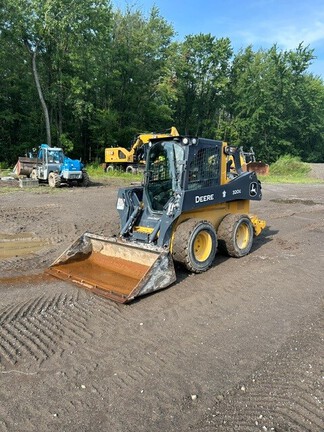
| John Deere (G series) | 316GR | 317G, 318G, 320G, 324G, 332G, 333G | R after the G = radial |
| Cat D3 skid steers | 226D3, 236D3, 246D3 | 232D3, 242D3, 262D3, 272D3 | No pattern, check the list |
| Cat D3 track loaders | 239D3, 279D3 | 249D3, 259D3, 289D3, 299D3 | No pattern; the D series split the same way |
| Bobcat | S450, S630 | S590, S650 | No letter code, check the model |
| Kubota | None listed here | SVL97-2 | Kubota markets its vertical lift on the SVL |
Sources: Case SR175B, SV340B, TV450B; Takeuchi TL8R2, TL10V2; John Deere G-series spec sheets; Cat D3 and D series spec sheets; Bobcat model pages; Kubota SVL97-2 brochure.
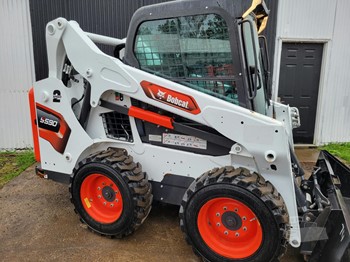
Be careful with Bobcat. The S650 is vertical, not radial; its radial counterpart in the same M-Series was the S630. Bobcat’s own description of the S630 calls it “radius lift path” with “greater forward reach at mid-range heights,” and the S650 “vertical lift path” with “greater forward reach at full lift height for loading over dump trucks.” When the name does not tell you, look up the exact model on the manufacturer’s site before you rely on a listing description.
2. Look at the arms
- Radial: each arm runs in one piece from a single pivot pin high on the rear tower down to the bucket. There is no extra link between the arm and the frame behind the cab.
- Vertical: look behind and beside the cab for a short extra link or lever on each side that ties the arm to the frame. You will see more pins at the back of the machine.
3. Watch it lift
Ask the seller to raise the empty bucket slowly while you stand to the side. A radial bucket moves out, then curves back toward the cab near the top. A vertical bucket goes almost straight up and drifts forward at the end. This takes ten seconds and settles it, even on an older machine with a worn decal.
Which lift path is for sale in Pennsylvania right now
We matched the 75 skid steers and compact track loaders listed by Pennsylvania dealers on Heavy Listing on November 12, 2026 against the manufacturer statements above. We could confirm the lift path on 31 of them. Vertical lift outnumbers radial four to one.
| Lift path | Machine | Year | Hours | Asking price |
|---|---|---|---|---|
| Radial | Bobcat S450 | 2018 | 717 | $27,500 |
| Radial | Bobcat S630 | 2011 | 1,276 | $28,500 |
| Radial | Takeuchi TL8R2 (tracks) | 2021 / 2023 | 2,033 / 1,900 | $25,000 / $29,900 |
| Radial | Case TR340B (tracks) | 2021 | 3,524 | $34,500 |
| Radial | Takeuchi TL12R2 (tracks) | 2022 | 2,300 | $57,900 |
| Vertical | Bobcat S650 (3) | 2018 to 2019 | 422 to 6,535 | $17,500 to $37,500 |
| Vertical | Bobcat S590 (2) | 2025 | Not listed | $45,900 / $52,900 |
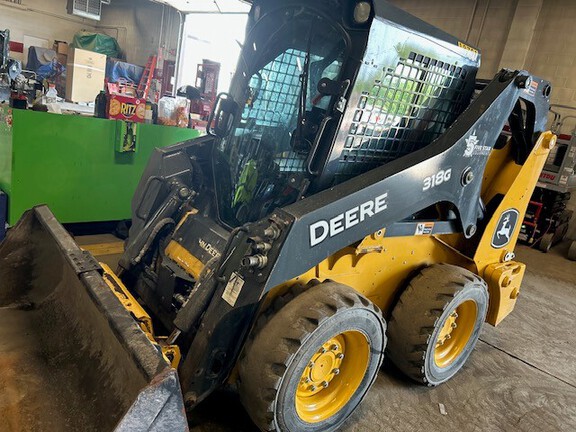
| Vertical | John Deere 318G | 2024 | 908 | $35,000 |
| Vertical | John Deere 320G | 2023 | 535 | $43,000 |
| Vertical | John Deere 332G | 2020 | 1,400 | $49,500 |
| Vertical | Track loaders: Cat 249D, 249D3, 259D, 259D3, 289D3; Deere 317G, 333G; Kubota SVL97-2; Case TV450B; Takeuchi TL10V2 (17) | 2015 to 2024 | 400 to 3,945 | $28,500 to $67,900 |
Source: Heavy Listing inventory, Pennsylvania dealers, November 12, 2026. The other 44 machines are models whose lift path we could not confirm from a current manufacturer source, so they are left out rather than guessed.
What this means if you are shopping: a vertical lift machine is easy to find in almost any size and budget. A radial machine takes more looking, especially on wheels, where we found only two. If you need radial for grading or dirt work, widen the search to track loaders, where the Takeuchi and Case R models show up, and compare prices with our used skid steer price guide and used compact track loader prices.
When you need more height than either one
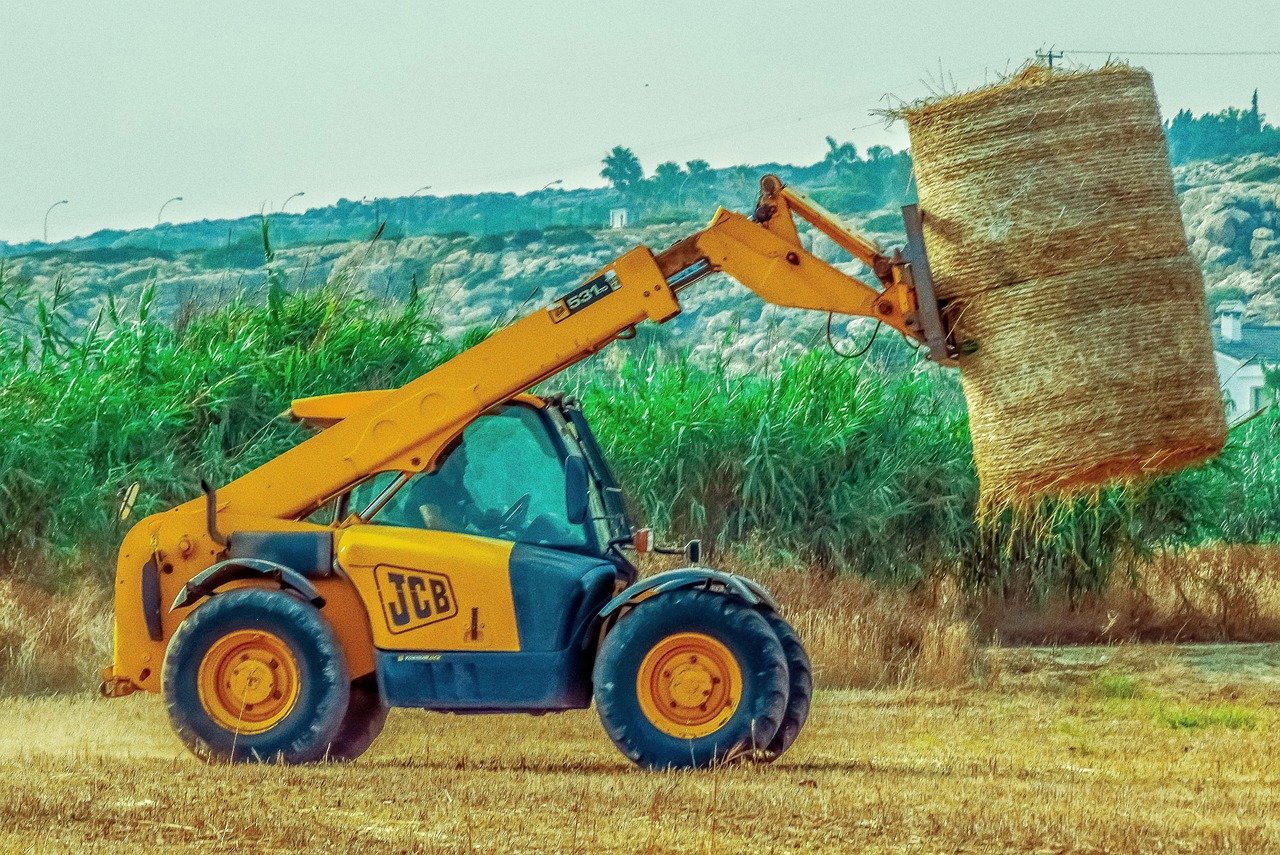
Every machine in this article tops out with the bucket hinge pin between about 9.5 and 10.5 feet. Vertical lift moves the bucket forward at that height. It does not add much height. If your work is stacking pallets on a second-floor deck, filling a high hopper or placing hay or block well above a truck, a skid steer is the wrong tool whichever arms it has. That is telehandler work.
Buying used: what the lift path changes in your inspection
Lift path changes what wears. Check these on top of the usual items in our used skid steer and CTL inspection checklist.
- ❌ Checking only the main arm pivot on a vertical machine. ✅ Check every pin on the rear links too: raise the arms halfway and rock the bucket to feel for play at each joint.
- ❌ Assuming the listing says the right lift path. ✅ Confirm by the model number and by watching the arms go up.
- ❌ Buying vertical “just in case” for pure grading work. ✅ If you never load high trucks, a radial machine is lighter and has fewer pins to grease.
- ❌ Buying radial to load tandem dump trucks. ✅ Look at full-height reach on the spec sheet; on the Deere pair it is 15.8 against 34 inches.
- ❌ Comparing capacity across the two without context. ✅ Expect the vertical twin to rate higher; the Cat and Deere pairs show 195 to 670 lb more.
- ❌ Forgetting the weight. ✅ The vertical twins above run 360 to 820 lb heavier, which counts against your trailer and tow vehicle.
Find the right lift path at the right price
Browse used skid steers from Pennsylvania dealers, check the model number against the tables above, and contact the dealer directly.
Browse used skid steers →The bottom line on radial vs vertical lift
Radial vs vertical lift comes down to where your bucket spends its day. Low and out in front, digging, grading and dumping over walls: radial. High and over the side of a truck, or carrying heavy loads on forks: vertical. The spec sheets back it up: on matched Cat and Deere pairs, the radial machine wins reach at mid height and the vertical machine wins reach at the top plus rated capacity. On the used market in Pennsylvania, vertical is what you will mostly find, so if you want radial, start looking early and include track loaders.
FAQ
Which is better, radial or vertical lift?
Neither is better overall. Radial lift is better for digging, grading, backfilling and loading flatbeds because it reaches farthest at mid height. Vertical lift is better for loading dump trucks, dumpsters and pallets because it reaches farthest at full height and carries more rated capacity on the same frame.
Is the Bobcat S650 radial or vertical lift?
Vertical. Bobcat describes the S650 as a vertical lift path machine with “greater forward reach at full lift height for loading over dump trucks.” Its radial counterpart was the S630.
Does a vertical lift skid steer lift higher?
Not always. On Cat’s matched pairs, pin height differs by less than an inch. On John Deere’s 316GR and 318G, the vertical machine’s hinge pin is 4.9 inches higher. The bigger difference is forward reach at the top: 7 to 18 inches more for the vertical machine on the pairs in this guide.
Why do vertical lift skid steers have a higher rated capacity?
The linkage keeps the load closer to the machine through the lift, so the same frame can carry more before it tips. On the Cat 246D3 and 262D3, rated operating capacity goes from 2,200 to 2,700 lb.
Is radial lift better for grading?
Manufacturers aim their radial machines at grading and dirt work. Deere says the radial 316GR excels “at digging, grading, and backfilling,” and Takeuchi pitches its radial TL12R2 for grading performance. A vertical machine can still grade well, but you pay for weight and linkage you are not using.
How do I know if a used skid steer is radial or vertical?
Check the model name first: on Case and Takeuchi, R means radial and V means vertical, and Deere G-series radial models end in GR. Then look for extra links between the arm and the frame behind the cab, which mean vertical lift, and watch the bucket go up: an arc that curls back toward the cab is radial.