
Most mini excavators spend their lives with a bucket on the stick, and a lot of them should have a thumb too. The attachments that really change what the machine can do (a thumb, a tilt bucket, an auger, a hammer, a tiltrotator) all depend on three things: how the attachment hangs on the stick, which hydraulic circuit drives it, and how much oil that circuit delivers. Get one wrong and the attachment will not mount, or it mounts and runs at half speed.
This guide covers the mini excavator attachments you will see most on dealer lots, what each one needs from the machine, how pin-on, pin grabber and hydraulic couplers differ, and what to check when a used mini comes with attachments. Flow figures come only from manufacturer spec sheets we opened. Market data comes from the 16 mini excavators Pennsylvania dealers had listed on Heavy Listing on November 23, 2026. If you came from the skid steer side, our skid steer attachments guide covers loader tools; the coupler and plumbing rules on an excavator are different.
Mini excavator attachments list: what each one needs
These are the attachments we see most often on used minis and in dealer attachment catalogs. The “needs” column is what the machine must have for the attachment to work, not what is nice to have.
| Attachment | What it does | Hydraulics needed | What else it needs |
|---|---|---|---|
| Digging (trenching) bucket | Digs footings, trenches and holes | None | Pins or a coupler that match the stick |
| Grading / ditching bucket | Wide, smooth-edged bucket for finish grade and ditch cleaning | None | Same mounting as the digging bucket |
| Mechanical thumb | Clamps rock, brush, logs and pipe against the bucket | None | A bracket welded or bolted to the stick; position set by hand with a pin |
| Hydraulic thumb (clamp) | Same job, controlled from the seat | A hydraulic circuit to the thumb cylinder | A thumb-ready stick and mount; some arms cannot take one |
| Tilt bucket or tilt coupler | Angles the bucket side to side for slopes and ditches | Two-way auxiliary | Matching coupler system |
| Auger | Drills post, pier and tree holes | Two-way auxiliary, within the motor’s flow range | Mounting bracket for the machine size |
| Hydraulic hammer (breaker) | Breaks concrete, rock and frozen ground | Auxiliary, usually set to one-way return | Mounting bracket; the maker may require a front screen |
| Plate compactor | Compacts backfill in trenches | Auxiliary | Mounting for the machine size |
| Tiltrotator | Rotates the attachment 360 degrees and tilts it side to side | Auxiliary plus its own control setup | Carrier weight inside the tiltrotator’s range; dealer installation |
| Quick coupler | Lets you swap buckets and tools without driving pins by hand | None on a manual coupler; a hydraulic circuit on a hydraulic coupler | Attachments built for that coupler, or for its pin spacing |
Sources: John Deere 35 P-Tier spec sheet and compact construction attachments catalog; Bobcat clamp and tilt coupler pages. Opened November 24, 2026.
If we were setting up a used mini for general contracting, the order would be: a digging bucket, a grading bucket, a thumb, then the one tool your work calls for. Augers and hammers rent easily, so rent first unless you run them every week.
Auxiliary hydraulics on a mini excavator: one-way, two-way and flow
The auxiliary circuit is the pair of hydraulic lines that runs down the boom and stick to power an attachment. On John Deere’s 35 P-Tier, the spec sheet lists as standard “auxiliary hydraulic lines with quick-couplers to end of boom,” a right-hand pilot-lever control and an “auxiliary return-flow selector valve.” Deere explains what that valve is for: it “accommodates hydraulic-driven attachments that operate either one or two ways.”
- One-way (single-acting) tools take oil in one line and send it back to tank. A hammer is the classic case.
- Two-way (double-acting) tools use both lines and reverse. An auger has to back out of the hole; a tilt coupler tilts both ways.
Then comes the flow, which grows with the size of the machine:
| Machine | Auxiliary flow | Auxiliary pressure | Second auxiliary circuit |
|---|---|---|---|
| John Deere 26 P-Tier | 12.2 gpm (46.18 L/min) | Not printed on the sheet | Not listed |
| John Deere 35 P-Tier | 16.2 gpm (61.2 L/min) | Not printed on the sheet | Not listed |
| John Deere 50 P-Tier | 23.1 gpm (87.4 L/min) | Not printed on the sheet | Not listed |
| Bobcat E35 | 16.9 gpm, selectable flow standard | 2,987 psi | Optional (flow not published) |
Sources: John Deere spec sheets for the 26 P-Tier, 35 P-Tier and 50 P-Tier; Bobcat E35 specs. Opened November 24, 2026.
These are current models. A 2016 26G or a 2005 Yanmar has its own figure, so look up that model and year. And “has aux” is not “has enough aux”: a tool rated for a 50-class machine can hook up to a 26-class machine and still crawl. For how the size classes compare, see our mini excavator sizes chart.
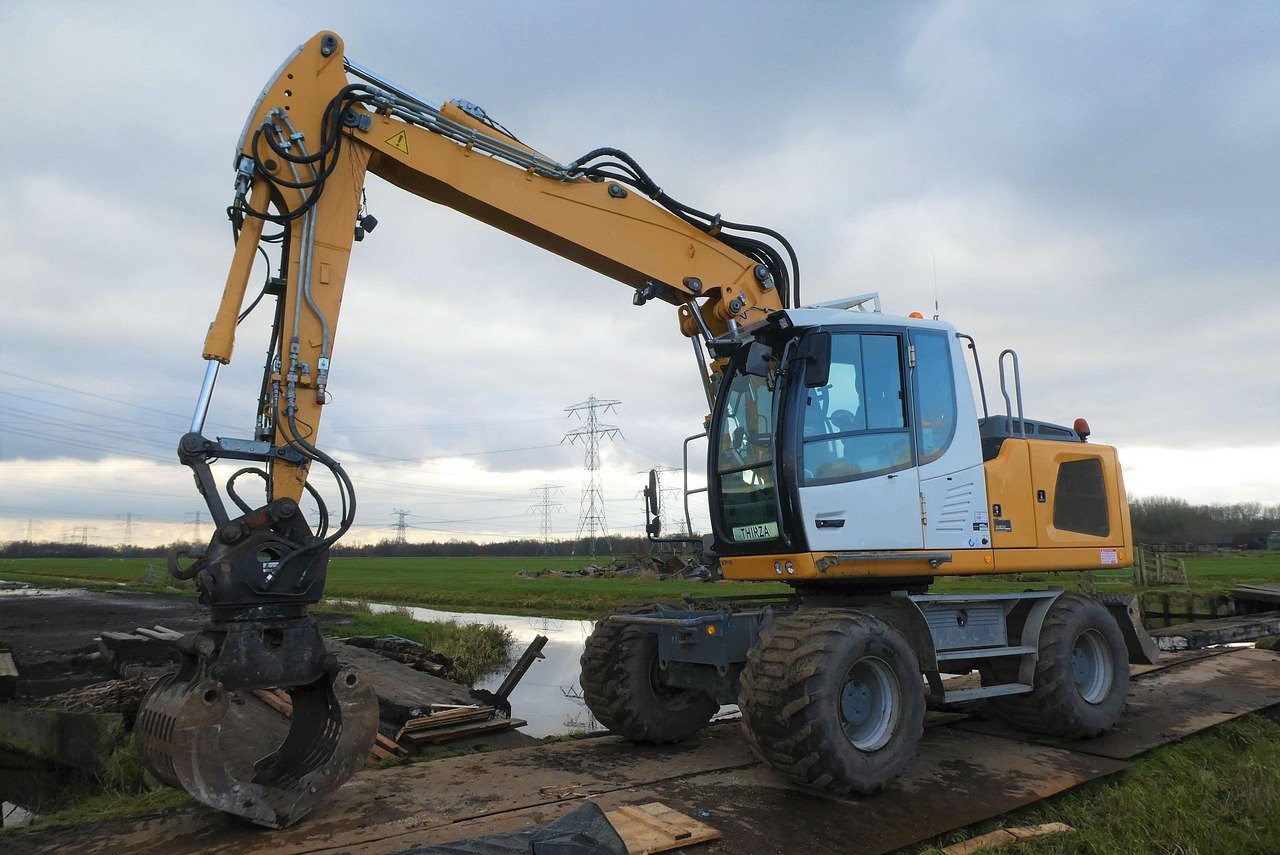
Mini excavator thumb: hydraulic vs mechanical
A thumb turns the bucket into a hand: rock, broken concrete, stumps, brush and pipe get picked up instead of pushed around. On a used mini it is the attachment we would pay extra for first.
Mechanical thumb. A tine bolted or welded under the stick, with a strut you pin in one of several holes; you close the bucket against it to grip. Cheaper, no hoses, almost nothing to break. But you get out of the seat to reposition it.
Hydraulic thumb. A cylinder moves the thumb from the seat, so you can grab, release and fold it away mid-cycle. It needs hydraulic oil to that cylinder. Depending on the machine, that comes from a dedicated thumb circuit or from the auxiliary circuit. If it uses the auxiliary circuit, you cannot run the thumb and a hammer or auger at the same time without swapping hoses, unless the machine has a second auxiliary circuit. Bobcat lists that second circuit as an option on the E35, so ask.
What the manufacturers say about fit:
- Bobcat offers a standard clamp as “a factory-installed option on most compact excavator models” and a Pro Clamp as a dealer-installed option. Its clamps work with standard and long arms “but cannot be used with the extendable arm,” and are “available for both the Bobcat X-Change and pin-grabber coupler systems.”
- John Deere lists a clamp as an optional front attachment on the 26 P-Tier and 35 P-Tier, next to augers and hammers. The mechanical quick-coupler is standard on both.
When a listing says “thumb,” ask which kind. “Hyd thumb” and “manual thumb” are two very different machines when you start picking up rock.
Tilt buckets and tilt couplers
A tilt bucket, or a tilt coupler with a regular bucket, angles the bucket left and right to cut a slope or clean a ditch without repositioning the machine. Landscapers and ditch crews use them all day; most other buyers never miss one.
Bobcat publishes two tilt options for its compact excavators, both for machines with its X-Change mounting:
- Hydra-Tilt: angles the bucket “30° left or right (60° total tilt).”
- PowerTilt: “delivers 90° of swing left or right (180° total rotation),” aimed at working around obstacles.
Bobcat notes you need “the right auxiliary hydraulics to run the tilt/swing function,” in practice a two-way circuit. On a used one, look for leaks and play at the tilt pivot and run it full travel both ways.
Source: Bobcat tilt couplers.
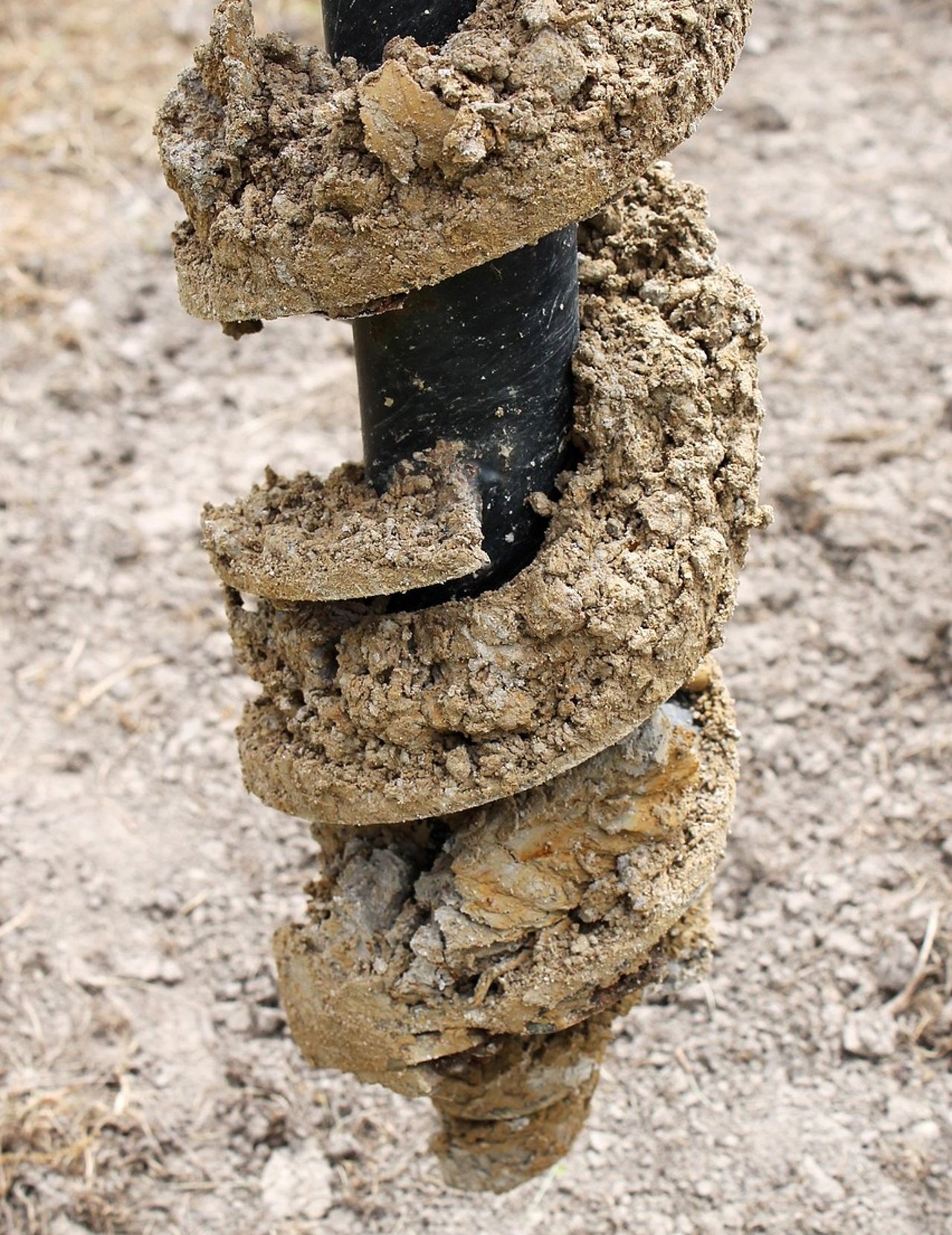
Mini excavator auger: flow ranges and brackets
An auger is a hydraulic motor, a gearbox and a bit. The motor is built for a flow range: too little oil and it turns slowly, too much and you are outside the rating. John Deere publishes the ranges for its augers, which makes them a good example of how to match one:
| Deere auger | Hydraulic flow (min to max) | Max pressure | Max bit diameter | Compact excavators listed |
|---|---|---|---|---|
| PA15B | 6 to 17 gpm | 3,500 psi | 24 in | 17, 26, 30 and 35 P-Tier |
| PA30B | 15 to 30 gpm | 3,500 psi | 36 in | 50 and 60 P-Tier |
Source: John Deere compact construction attachments catalog (augers). The PA40 is listed for skid steers, track loaders and wheel loaders only.
Line those up with the flow table: the 26 and 35 P-Tier (12.2 and 16.2 gpm) sit inside the PA15B’s 6 to 17 gpm; the 50 P-Tier (23.1 gpm) needs the PA30B. The same check works for any brand: read the motor’s flow range on its decal and compare it to the machine’s auxiliary flow. Then check that the auger’s mounting bracket fits that machine’s pins or coupler.
Hydraulic hammer (breaker) on a mini excavator
A hammer is the attachment most likely to wear out the machine carrying it, and sellers do not always mention that a mini ran one. Deere’s catalog lists four compact hammers:
| Deere hammer | Hydraulic flow | Weight with excavator mount | Compact excavators listed |
|---|---|---|---|
| HH20C | 6.6 to 14.5 gpm | 415 lb | 17, 26, 30 and 35 P-Tier |
| HH40C | 10.6 to 18.5 gpm | 566 lb | 26, 30 and 35 P-Tier |
| HH60C | 9.2 to 23.8 gpm | 650 lb | 35, 50 and 60 P-Tier |
| HH80C | 10.6 to 31.7 gpm | 840 lb | 50 and 60 P-Tier |
Source: John Deere compact construction attachments catalog (hydraulic hammers). All four list a 3,190 psi pressure relief.
Two footnotes in that catalog matter more than the numbers. Every compact excavator hammer requires a specific mounting bracket, and “all older mounting brackets will not interchange.” And for the compact excavators, Deere lists a front protection screen as required, with a part number for each machine and for cab or canopy. A used mini sold with a hammer but no front screen is missing a part the maker calls for.
Quick couplers: pin-on, manual, pin grabber and hydraulic
On a skid steer the attachment plate is close to universal. On a mini excavator it is not. Here is how the four setups you will meet compare:
| Setup | How it works | Good | Watch for |
|---|---|---|---|
| Pin-on (no coupler) | Bucket pinned straight to the stick and link | Nothing between stick and bucket; simple | Every swap means driving pins by hand; pin sizes must match |
| Manual (mechanical) coupler | Coupler stays on the stick; you lock each tool with a pin or lever | Fast swaps, no extra hydraulics | Operator gets out to lock it, and it only works if someone does |
| Pin grabber | Coupler grabs the attachment’s own pins | Takes pin-on tools that match its pin size and spacing | Range of pin sizes it can grab; wear in the jaws |
| Hydraulic coupler | Locks from the seat with a switch | Swaps without leaving the cab | Needs a working circuit and lock indicator; test it |
Brand examples, from the makers’ own pages:
- John Deere lists a mechanical quick-coupler as standard on the 26 P-Tier and 35 P-Tier, and says its wedge-style coupler takes buckets, hammers, plate compactors and augers.
- Bobcat X-Change uses “a pin-and-hook design.” On the mechanical version, operators “must leave the cab to secure a single pin.” With the Hydraulic X-Change, an in-cab switch runs the retention pins, but “attachments cannot be mounted in reverse.”
- Bobcat Hydraulic Pin-Grabber locks from the seat with “simple in-cab switches” and “supports reverse-bucket mounting (shovel mode) for digging beneath obstacles.”
The lesson: a bucket built for one brand’s coupler will not necessarily hang on another’s, even on the same size machine. Buy buckets that fit the coupler, or check that it can grab the pins on the buckets you own.
Sources: John Deere 35 P-Tier; Bobcat Hydraulic X-Change, mechanical X-Change and Hydraulic Pin-Grabber.
The coupler is a safety device
OSHA’s bulletin on excavator quick couplers (SHIB 07-22-2005) came out of a fatal accident in Wisconsin: an operator changed buckets, swung back to the trench, and the bucket came off and killed a worker in the lateral. The investigation found that a locking pin “had not been manually installed.” OSHA’s data showed 15 incidents since January 1998 of buckets coming off quick couplers on hydraulic excavators, with eight workers killed, and said most releases are “likely caused by the failure to properly engage and lock the quick couplers.”
OSHA recommends the manufacturer’s retrofit locking pins, an independent secondary system to hold the tool if the primary lock fails, and testing the connection every time an attachment is changed. Our habit: after a swap, press the bucket against the ground before you dig. If it shifts, it is not locked.
Tiltrotators: the most capable and the most complicated
A tiltrotator sits between the stick and the attachment. It rotates the tool 360 degrees and tilts it side to side, so the operator can grade around a foundation or dig under a utility line without moving the tracks. None of the mini excavators listed by Pennsylvania dealers on Heavy Listing on November 23, 2026 mentions one.
John Deere sells engcon tiltrotators through its catalog. The two compact models show what a buyer should check:
| engcon model (Deere catalog) | Tilt range | Recommended carrier weight | Max pressure | Weight | Deere machines listed |
|---|---|---|---|---|---|
| EC204 | ±45 degrees | 4,400 to 8,800 lb | 3,200 psi | 255 lb | 26, 30 and 35 P-Tier |
| EC206 | ±45 degrees | 8,800 to 13,200 lb | 3,200 psi | 374 lb | 50 and 60 P-Tier |
Source: John Deere compact construction attachments catalog (engcon tiltrotators).
What makes them different:
- Carrier weight is part of the spec. The tiltrotator is sized to the machine, not only to its hydraulics. Check the weight of the mini (our guide to how much a mini excavator weighs has the figures) against the tiltrotator’s range.
- It adds weight and length at the end of the stick. That costs lift capacity and some breakout force. Deere notes the operator can disconnect the tiltrotator through the automatic quick-coupler “for maximum breakout force or when lifting.”
- It is a system, not a bolt-on. Rotation, tilt and any tool on it need hydraulic functions and controls in the cab. A used mini with a tiltrotator should come with its control hardware and the installer’s paperwork, or be priced as a mini with an expensive problem on the stick.
What the Pennsylvania listings show about aux hydraulics and thumbs
On November 23, 2026, Pennsylvania dealers had 16 mini excavators available on Heavy Listing, from USD 14,500 to 99,400. Nine of the 16 listings note auxiliary hydraulics in the specs field:
- 2024 John Deere 35 P-Tier, 210 hours, USD 49,500, enclosed cab
- 2023 John Deere 26G, 1,774 hours, USD 29,500, and a 2016 26G, 2,035 hours, USD 24,500
- 2022 Cat 303CR, 2,348 hours, USD 37,500, and a 2019 Cat 303.5E2 CR, 3,257 hours, USD 32,500
- 2019 Cat 308E2 CR and 2019 Cat 310, both enclosed cab
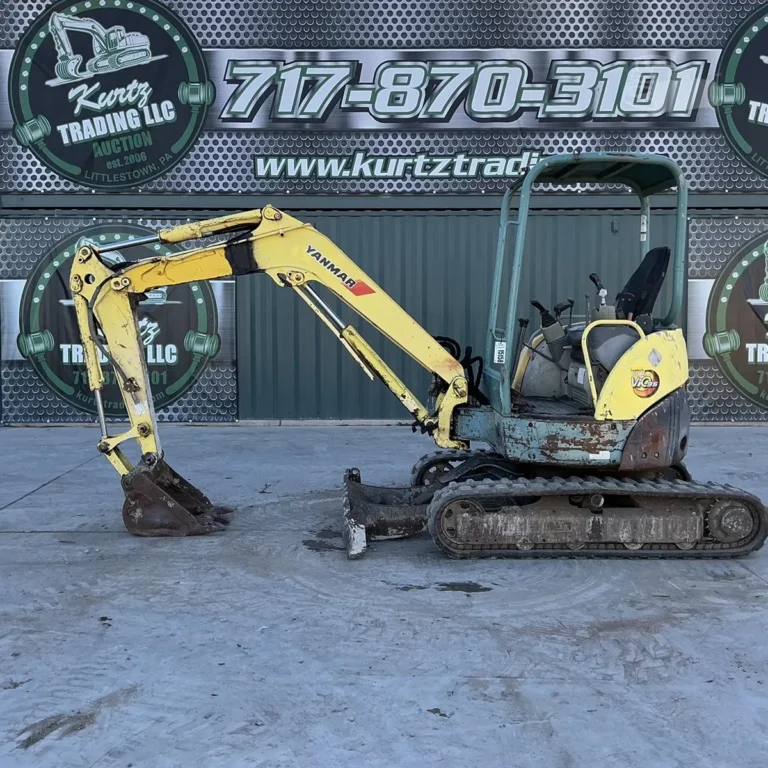
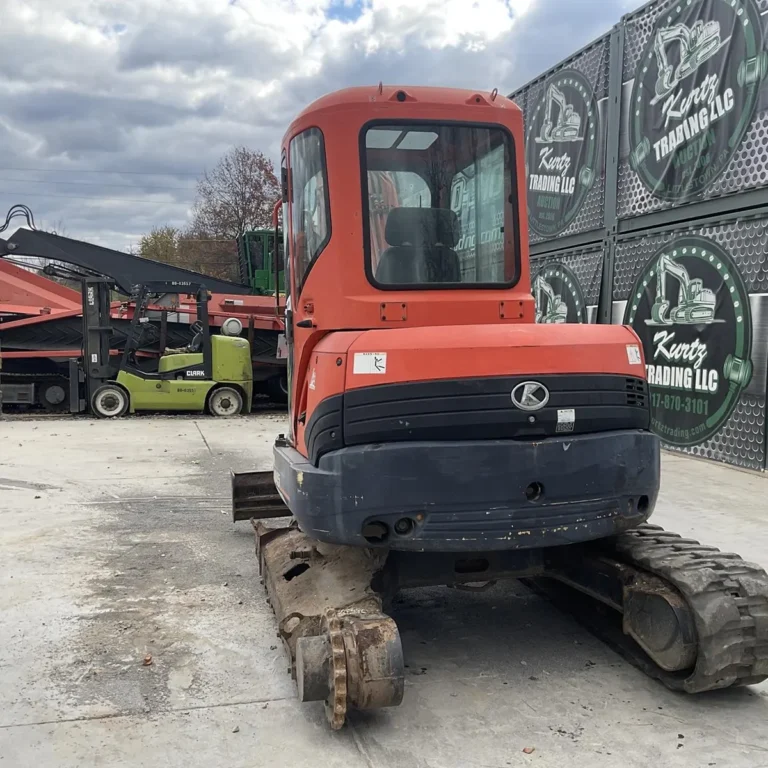
- 2005 Yanmar VIO35 (USD 14,500) and 2006 Kubota U45-3 (no price published)
None of the 16 mentions a thumb in its specs field, and seven do not say either way on auxiliary hydraulics; several dealers simply leave the field empty. Ask for a photo of the end of the stick: aux lines, a thumb bracket or a coupler are easy to see. For what these machines sell for, see our guide to used mini excavator prices.
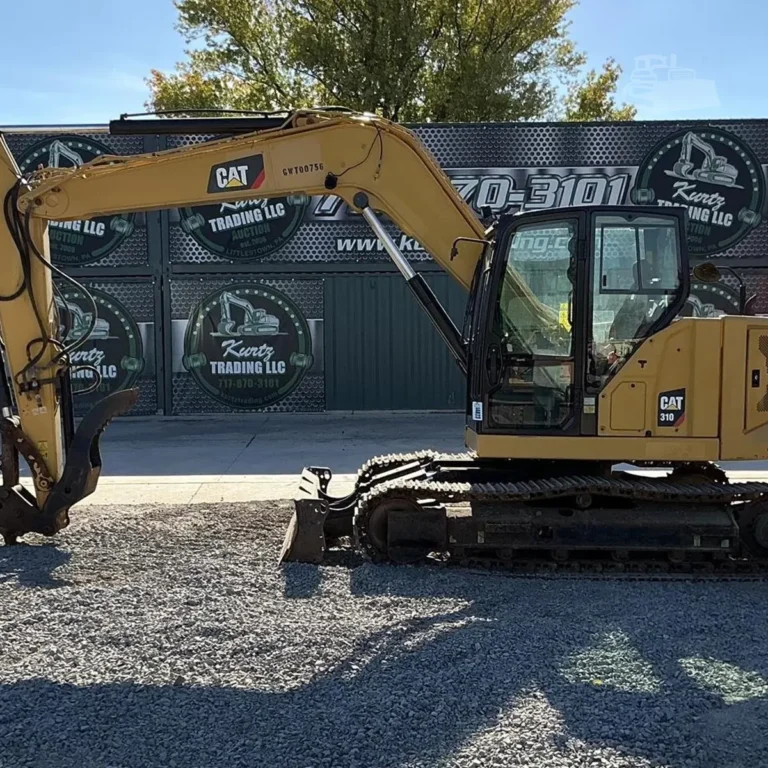
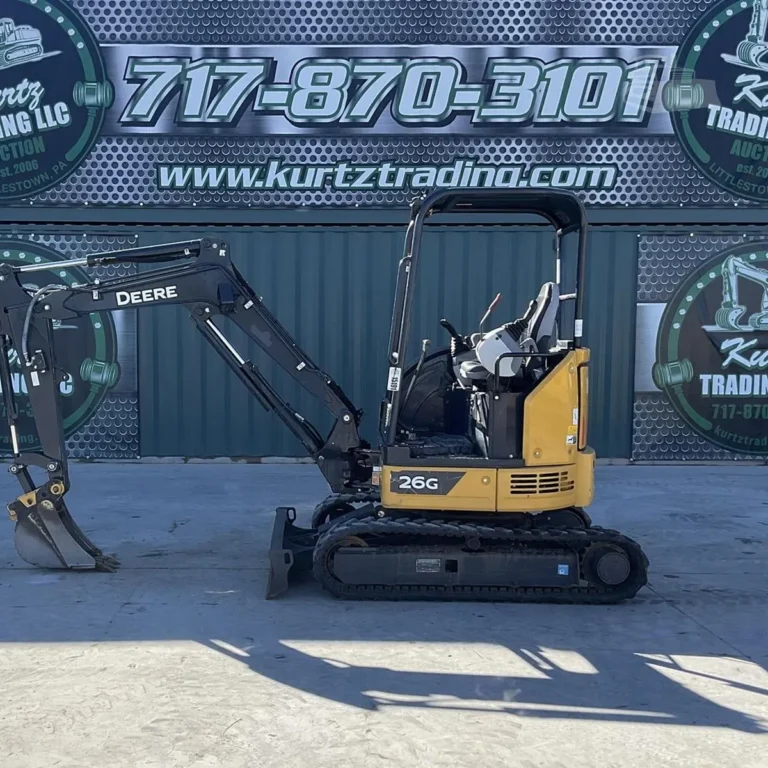
Some of the mini excavators Pennsylvania dealers have listed right now:
How to check attachments on a used mini excavator
Do this on top of a full used excavator inspection checklist. Attachments add a few failure points of their own:
- Look at the stick end. Cracks at the pin bosses, bucket link or coupler mounts, or fresh weld beads, mean it has been overloaded or beaten.
- Shake the bucket. Curl it against the ground and rock the machine. Clunks at the pins or the coupler mean worn pins and bushings.
- Lock and unlock the coupler several times. On a manual coupler, the locking pin should go in fully and be present. On a hydraulic coupler, check the switch, the indicator, and whether it holds with the engine off.
- Run the auxiliary circuit both ways. Hook up a two-way tool if the seller has one. Couplers should connect without a fight and not drip. Switch the selector valve and confirm both positions work.
- Work the thumb. On a hydraulic thumb: full travel, no drift when held, no leaks at the cylinder. On a mechanical thumb: holes and pin not wallowed out, no cracks at the mount.
- Ask what the machine ran. Years on a hammer shake a mini harder than years of trenching, and hours alone will not tell you (see how many hours is a lot). A hammer bracket in the pile is a clue.
- Get the list in writing. Which buckets, thumb, coupler and tools are in the asking price, and which are “available separately.”
Common mistakes with mini excavator attachments
- ❌ Buying a hammer because “it fits the pins.” ✅ Check its flow range against the machine’s auxiliary flow, and get the right bracket and front screen.
- ❌ Assuming every mini has a two-way circuit set up for an auger. ✅ Find the selector valve or ask the dealer how the circuit is plumbed.
- ❌ Planning to run a hydraulic thumb and a hammer off one circuit without swapping hoses. ✅ Ask about a second auxiliary circuit before you buy.
- ❌ Buying buckets for a different brand’s coupler. ✅ Match the coupler, or the pin size and spacing it grabs.
- ❌ Swapping attachments and digging without checking the lock. ✅ Lock, verify, press the bucket down, then work.
Find a mini excavator set up for your attachments
Browse used mini excavators from Pennsylvania dealers with year, hours and asking price on each listing. Call the dealer and ask about auxiliary hydraulics, the thumb, the coupler and which buckets come with it.
Browse used mini excavators →The bottom line
Buckets and a mechanical thumb work on any mini. Everything else runs on the auxiliary circuit, so the questions about a used mini excavator’s attachments are always the same: how much flow, one-way or two-way, is there a second circuit, and what coupler is on the stick. Match the attachment’s flow range to the machine and check the coupler lock every time. If the mini is coming home on your own trailer with a hammer and three buckets, add their weight before you haul it; our guide to transporting heavy equipment in Pennsylvania covers the rules.
FAQ
What attachments can a mini excavator use?
Digging, grading and ditching buckets, mechanical and hydraulic thumbs, tilt buckets and tilt couplers, augers, hydraulic hammers, plate compactors and, on suitable machines, tiltrotators. Buckets and mechanical thumbs need no auxiliary hydraulics; the rest do.
Do you need auxiliary hydraulics for a thumb on a mini excavator?
Not for a mechanical thumb, which you set with a pin. A hydraulic thumb needs oil to its cylinder, either from a dedicated thumb circuit or from the auxiliary circuit. If it uses the auxiliary circuit, you need a second circuit to run another hydraulic tool without swapping hoses.
How much hydraulic flow does a mini excavator have for attachments?
It depends on size. John Deere prints 12.2 gpm on the 26 P-Tier, 16.2 gpm on the 35 P-Tier and 23.1 gpm on the 50 P-Tier; Bobcat prints 16.9 gpm at 2,987 psi on the E35. Older models differ, so look up the exact model and year.
What is the difference between a pin grabber and a hydraulic coupler?
A pin grabber clamps onto the attachment’s own pins, so it can take pin-on tools that match its pin size and spacing. “Hydraulic” describes how a coupler locks: from the seat with a switch instead of by hand. Bobcat’s Hydraulic Pin-Grabber is both, and it supports reverse bucket mounting.
Can you put a hammer on any mini excavator?
Only one matched to the machine. The hammer’s flow range has to fit the auxiliary flow, it needs a bracket for that machine, and some makers require a front protection screen. Deere, for example, lists its smallest compact hammer at 6.6 to 14.5 gpm for the 17 to 35 P-Tier.