Zero tail swing vs conventional excavator is a question about the back of the machine, not the front. When the upper house rotates, the counterweight swings around behind the operator. On a conventional excavator it sticks out past the tracks. On a zero tail swing (ZTS) excavator it stays inside them. That one dimension decides whether you can dig next to a house, work one lane of a road with traffic going by, or swing freely in an open field with more counterweight behind you.
This guide uses the manufacturers’ own spec sheets to compare matched pairs from Bobcat and Takeuchi. It also shows what extra counterweight does to a “zero” machine and what CR, R, SR, U and ZTS mean in model names. Then it lists which tail swing the mini excavators for sale from Pennsylvania dealers on Heavy Listing actually have. Still deciding on size? Read our mini excavator size guide first.
Zero tail swing vs conventional excavator: the short version
| Zero tail swing (ZTS) | Reduced / minimal / short tail swing | Conventional tail swing | |
|---|---|---|---|
| Rear of the house when it rotates | Stays inside the track width | Hangs a few inches past the tracks | Hangs well past the tracks (13 to 21 in on the pairs below) |
| Best at | Walls, foundations, fences, sidewalks, traffic lanes | Tight sites where a few inches of overhang is acceptable | Open ground, long trenches, lifting, tight gates |
| Machine width | Wider than its conventional twin | Usually wider than its conventional twin | Narrowest stance in its class |
| Where the weight sits | Packed over the tracks | Mostly over the tracks | Out behind, as a lever against the load |
| Typical name clues | ZTS, Kubota U17-5, Deere 35 P-Tier | Cat CR, Takeuchi R, Case SR, Kubota U | Kubota KX, Takeuchi TB235-2 and TB250-2, Bobcat E32 |
Sources: Bobcat E32 and E35 pages; Takeuchi compact excavator lineup; Kubota KX and U Series pages; John Deere 35 P-Tier spec sheet.
Zero tail swing, reduced tail swing and conventional: the definitions
Every excavator has a rear swing radius: the distance from the center of rotation to the farthest point of the counterweight. Compare it with half the width of the undercarriage. If the radius is bigger, the tail hangs over the tracks when the house turns sideways. The difference is the overhang, and it is the number that hits the wall.
Bobcat publishes the clearest set of definitions, and the rest of the industry uses the same terms more loosely:
- Zero tail swing (ZTS): “The rear of the house stays within the width of the tracks through full rotation.” Bobcat recommends it if you are “constantly working close to objects or against a wall.”
- Minimal tail swing: more maneuverable than conventional, “however the rear of the house protrudes as much as 6 in. beyond the width of the tracks.” Other brands call this reduced, short, tight or compact radius.
- Conventional tail swing: Bobcat says these models “deliver the greatest lift capacity in the excavator lineup” and “have a narrower stance (width) for easier loading onto a trailer and better access through doorways, gates, property lines.”
Kubota makes the same split in its two compact lines. Its KX Series uses a conventional tail swing and counterweight for “better weight distribution at the back end of the machine” and “added stability,” aimed at work “where space restrictions aren’t an issue.” Its U Series uses a “tight-tail or zero-tail swing” for close quarters “with no room for error.”
No standard sets these labels, so check the numbers. John Deere calls its 30 P-Tier “reduced tail swing,” yet its own spec sheet lists a 775 mm (31 in) tail swing radius on a 1.55 m (5 ft 1 in) undercarriage. Half of 1.55 m is 775 mm, so on paper the tail stays inside the tracks. The 26 P-Tier, also “reduced,” overhangs by about 2 inches by the same math. Labels are marketing. Overhang is geometry.
Matched pairs: what the spec sheets show
The cleanest way to see the trade is to compare twins from the same maker: same engine size or weight class, different tail. Bobcat publishes the overhang directly. Takeuchi publishes tail swing radius and undercarriage width, so we did the subtraction.
Bobcat E32 (conventional) vs Bobcat E35 (zero tail swing)
| Spec | Bobcat E32 conventional | Bobcat E35 ZTS |
|---|---|---|
| Engine | 24.8 hp | 24.8 hp |
| Weight class | 3 t | 4 t |
| Operating weight | 7,403 lb | 7,659 lb |
| Width | 61.8 in | 69.7 in |
| Tail swing overhang (standard arm) | 13.4 in | 0 in |
| Rated lift capacity (118 in radius) | 2,975 lb | 3,318 lb |
| Dig depth, standard arm | 10.1 ft | 121.2 in (10.1 ft) |
| Transport length | 183.7 in | 190 in |
Source: Bobcat E32 and E35 spec tables, checked November 24, 2026.
Same engine, same dig depth, and Bobcat sells them side by side. Bobcat says the E32 is “narrower than the E35” and “ideal if you frequently work around areas with space restrictions such as doors or gates.” The E35 is 7.9 inches wider and 256 lb heavier, and that extra width and weight is how it keeps the tail inside the tracks. It also rates 343 lb more lift capacity, so the “conventional always lifts more” rule does not hold here, because the E35 is a heavier class of machine. Compare lift charts model by model, not by label.
Takeuchi TB235-2 (conventional) vs Takeuchi TB335R (short tail swing)
| Spec | TB235-2 conventional | TB335R short tail swing |
|---|---|---|
| Engine | 24.4 hp | 24.4 hp |
| Operating weight, canopy | 7,416 lb | 7,970 lb |
| Undercarriage width | 5 ft 2.2 in (1,580 mm) | 5 ft 8.5 in (1,740 mm) |
| Tail swing radius | 4 ft 4.4 in (1,330 mm) | 3 ft 1.4 in (950 mm) |
| Overhang past tracks (our math) | About 21 in (540 mm) | About 3 in (80 mm) |
| Max digging depth | 10 ft 7.8 in | 10 ft 6.2 in |
| Ground pressure, canopy | 4.4 psi | 4.5 psi |
Source: Takeuchi TB235-2 and TB335R specifications. Overhang = tail swing radius minus half the undercarriage width.
Takeuchi says the TB235-2’s conventional tail “delivers stability and a larger operator’s station.” The TB335R is pitched for “less worry about impacts.” The difference is big: to spin the house a full turn, the TB235-2’s tail needs a circle about 8 ft 9 in across. The TB335R needs about 6 ft 3 in. The TB335R pays with 554 lb more weight and 6.3 inches more width.
Takeuchi TB250-2 (conventional) vs Takeuchi TB350R (reduced tail swing)
| Spec | TB250-2 conventional | TB350R reduced tail swing |
|---|---|---|
| Operating weight, canopy | 10,970 lb | 10,980 lb |
| Undercarriage width | 6 ft 0.4 in (1,840 mm) | 6 ft 6.7 in (2,000 mm) |
| Tail swing radius | 4 ft 5.5 in (1,360 mm) | 3 ft 6.3 in (1,075 mm) |
| Overhang past tracks (our math) | About 17 in (440 mm) | About 3 in (75 mm) |
| Max digging depth | 12 ft 4.8 in | 11 ft 8.8 in |
Source: Takeuchi TB250-2 and TB350R specifications.
At 5 tons the weights are identical, but the reduced-tail TB350R is 6.3 inches wider and digs 8 inches shallower. On all three pairs the pattern is the same: the tight-tail machine moves weight from behind the operator to the sides, so it gets wider. That is the trade you are buying.
Stability and lift: where the counterweight went
An excavator lifts against its own weight. Out over the front, the whole length of the tracks holds it down. Out over the side, only half the track width does, plus whatever counterweight sits on the far side. A conventional tail puts that weight farther out, which is why Bobcat credits conventional models with the most lift and Kubota talks about “better weight distribution at the back end.”
Deere’s 35 P-Tier spec sheet shows how much the side matters on a ZTS machine. Lifting at ground level, 10 feet out, with the standard arm and canopy:
| Deere 35 P-Tier (zero tail swing) | Over the front, blade down | Over the side | Tail swing radius |
|---|---|---|---|
| Standard counterweight (1,190 lb) | 3,453 lb | 1,412 lb | 870 mm (34 in): zero overhang on the 1.74 m undercarriage |
| Extra counterweight (+529 lb) | 3,453 lb | 1,686 lb | 980 mm (39 in) with long arm and extra counterweight: about 4 in past the tracks |
Source: John Deere 35 P-Tier specifications. Lift figures per ISO 10567, 75% of tipping or 87% of hydraulic capacity.
The chart shows two things. First, a ZTS machine lifts well under half as much over the side as over the blade, so plan lifts with the load in front. Second, extra counterweight buys side capacity but takes away the “zero.” Bobcat’s E35 shows the same thing: the long-arm and extendable-arm versions are listed with 3.2 inches of overhang. If a listing says “ZTS” and the machine has an add-on counterweight, measure it.
Where each one wins on the job
| Job | Better fit | Why |
|---|---|---|
| Foundation dig or footing against a house | Zero tail swing | You can swing to dump without the counterweight touching siding or forms |
| Utility cut in one lane with traffic in the next | Zero or reduced | The tail stays inside the cones, so you are not swinging into the open lane |
| Sidewalk, curb or driveway work in town | Zero or reduced | Less repositioning between poles, mailboxes and parked cars |
| Backyard behind a 5 ft gate | Conventional | The narrower stance gets through; Bobcat’s E32 is 61.8 in wide against 69.7 in for the E35 |
| Long trench across open ground | Conventional | Nothing to hit, and you keep the narrower, often cheaper machine |
| Setting pipe, boxes or stone over the side | Conventional, or ZTS with extra counterweight | Counterweight farther out means more capacity off the side |
| Inside a building or between columns | Zero tail swing | Full rotation without hitting the structure |
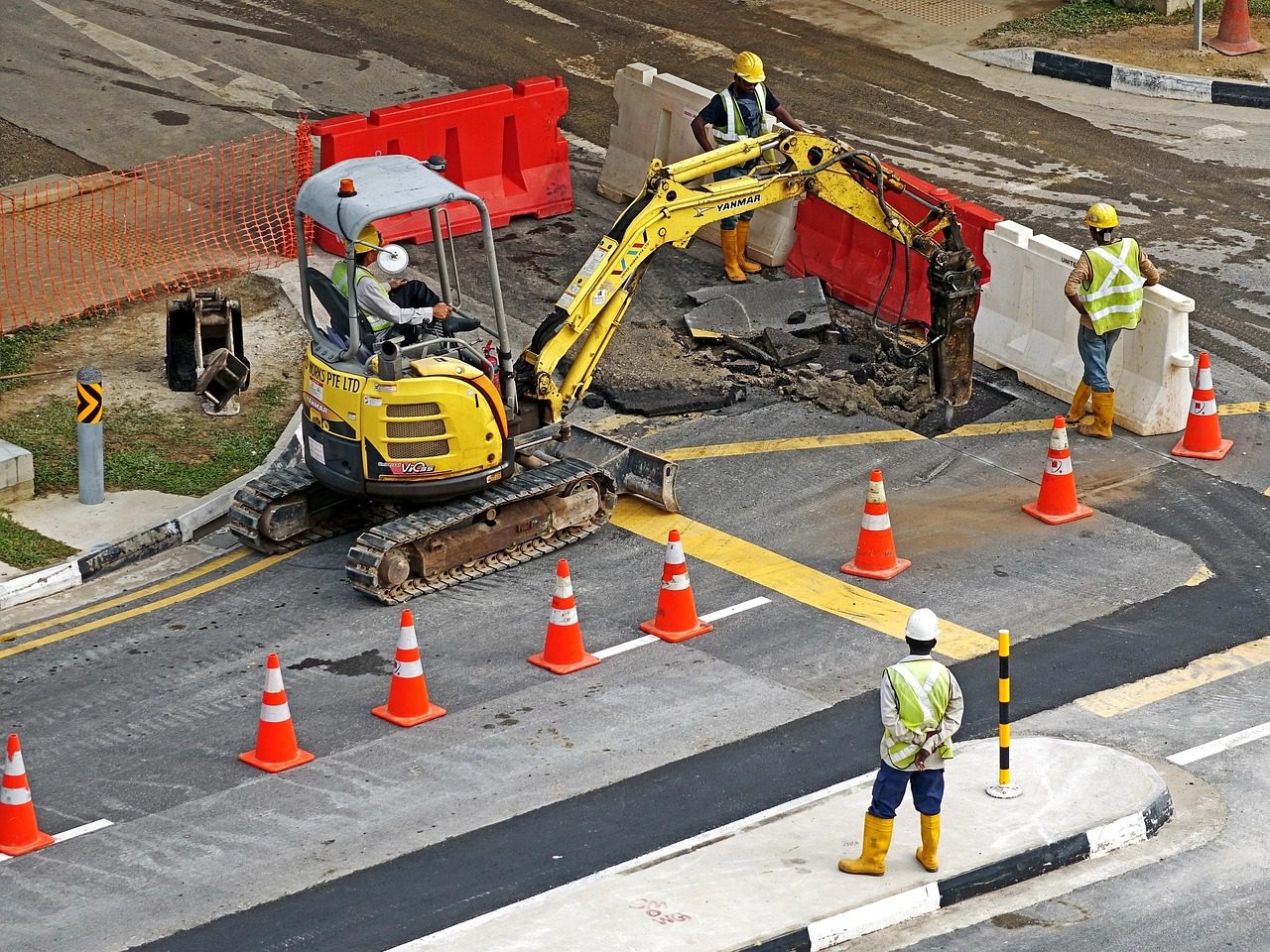
Our take: if your work is mostly residential and municipal, a ZTS or reduced tail machine is the safer default, because one scraped wall or damaged truck can cost more than the price gap between twins. If you dig farm drainage, field tile or long sewer runs on open ground, a conventional machine gives you a narrower trailer load and a counterweight that works for you.
Reduced tail swing on midi and larger excavators
“Reduced” covers a wide range. In John Deere’s lineup the tight-tail models above 3.5 tons are labeled reduced, and the overhang grows with the machine. Check it on the spec sheet before you assume a reduced-tail machine will clear a wall.
| Model | Maker’s label | Tail swing radius | Undercarriage width | Overhang past tracks (our math) |
|---|---|---|---|---|
| John Deere 26 P-Tier | Reduced tail swing | 0.80 m (31 in) | 1.50 m | About 2 in |
| John Deere 30 P-Tier | Reduced tail swing | 775 mm (31 in) | 1.55 m | 0 in |
| John Deere 60G | Reduced tail swing | 1.30 m (4 ft 3 in); 1.41 m with extra counterweight | 2.00 m | About 12 in; about 16 in with extra counterweight |
| John Deere 85 P-Tier | Reduced tail swing | 1.59 m (5 ft 3 in) | 2.20 m (18 in track) | About 19 in |
Sources: John Deere spec sheets for the 26 P-Tier, 30 P-Tier, 60G and 85 P-Tier.
Deere markets the 85 P-Tier’s reduced tail as “flexible performance in tight spaces compared to conventional tail-swing machines,” and it is far tighter than a full-size machine of the same weight. But 19 inches past the tracks is not something to run against a building. Case calls its 32,100 lb CX145D SR a “minimum-swing excavator” built with “a compact counterweight and modified boom placement” for road and bridge work, utilities and urban jobs. For full-size excavators, see the used excavator price guide.
What CR, R, SR, U and ZTS mean in model names
| Letters | Brand | Meaning | Examples |
|---|---|---|---|
| CR | Caterpillar | Compact radius: the tail stays close to the track width | 303 CR, 303.5E2 CR, 308 CR, 308E2 CR |
| LCR | Caterpillar (larger models) | Long undercarriage, compact radius | 328D LCR |
| R | Takeuchi | Short or reduced tail swing | TB335R, TB350R (TB235-2, TB240, TB250-2 are conventional) |
| SR | Case, Kobelco | Short radius / minimum swing | Case CX145D SR, Kobelco SK140SRLC-7 |
| U | Kubota | Tight tail or zero tail (U17-5 is zero) | U17-5, U45-3 (KX models are conventional) |
| ZTS | Generic | Zero tail swing, used by dealers and in listings | Bobcat E35, Deere 35 P-Tier |
| No letters | Bobcat, John Deere | Tail type is not in the name: check the spec sheet | Bobcat E32 (conventional) vs E35 (ZTS); Deere 26 P-Tier (reduced) vs 35 P-Tier (zero) |
Sources: Takeuchi, Kubota, Bobcat and Deere pages cited above; Case CX145D SR announcement. Cat’s product pages block automated checks, so the Cat rows rely on Cat’s model naming and are not backed by a spec sheet here.
The letter only tells you the family. It does not give you the overhang. A Cat “CR” or Takeuchi “R” can still poke a few inches past the tracks, and a “ZTS” machine with an extra counterweight may not be zero any more. Before you put a machine next to a wall, ask the dealer for the tail swing radius and the undercarriage width, or measure them yourself.
Tail swing on mini excavators for sale in Pennsylvania
We sorted the mini excavators listed by Pennsylvania dealers on Heavy Listing on November 23, 2026, plus the compact-radius and short-radius machines filed under full-size excavators. Tight-tail machines dominate. Five of the Cat machines carry “CR,” and every John Deere P-Tier on the list is reduced or zero tail swing.
| Tail swing | Machine | Year | Hours | Asking price |
|---|---|---|---|---|
| Zero (Deere) | John Deere 35 P-Tier | 2024 | 210 | $49,500 |
| Zero (Deere) | John Deere 35P | 2024 | 284 | $50,000 |
| Reduced (Deere) | John Deere 26 P-Tier | 2023 | 697 | $32,500 |
| Reduced (Deere) | John Deere 60G | 2023 | 943 | $73,350 |
| Reduced (Deere) | John Deere 85P | 2023 | 1,767 | $99,400 |
| Compact radius (CR) | Cat 303.5E2 CR | 2019 | 3,257 | $32,500 |
| Compact radius (CR) | Cat 303CR | 2022 | 2,348 | $37,500 |
| Compact radius (CR) | Cat 308E2 CR | 2019 | 4,454 | $46,500 |
| Compact radius (CR) | Cat 308E2 CR | 2015 | 5,366 | $48,500 |
| Compact radius (CR) | Cat 308 CR | 2021 | 2,953 | $69,500 |
| Tight tail (Kubota U) | Kubota U45-3 | 2006 | 2,642 | Call for price |
| Conventional (Takeuchi) | Takeuchi TB240 | 2016 | 1,946 | $39,500 |
| 12 in overhang (current Bobcat spec) | Bobcat E42 | 2020 | 2,418 | $39,500 |
| Not confirmed | John Deere 26G (2), Cat 310, Yanmar VIO35 | 2005 to 2023 | 1,774 to 5,725 | $14,500 to $69,500 |
Source: Heavy Listing inventory, Pennsylvania dealers, November 23, 2026. Tail swing type from the manufacturer sources above; Cat rows from the “CR” in the model name. Older machines (Kubota U45-3, Takeuchi TB240, Bobcat E42) are classed by the maker’s current description of the same model name. The four “not confirmed” machines are left out rather than guessed.
Larger reduced-tail machines in the same inventory: a 2025 John Deere 85P (925 hours, $126,000), a 2020 Case CX145D SR (3,637 hours, $64,900) and a 2022 Kobelco SK140SRLC-7 (1,359 hours, $105,500). They are filed under used excavators.
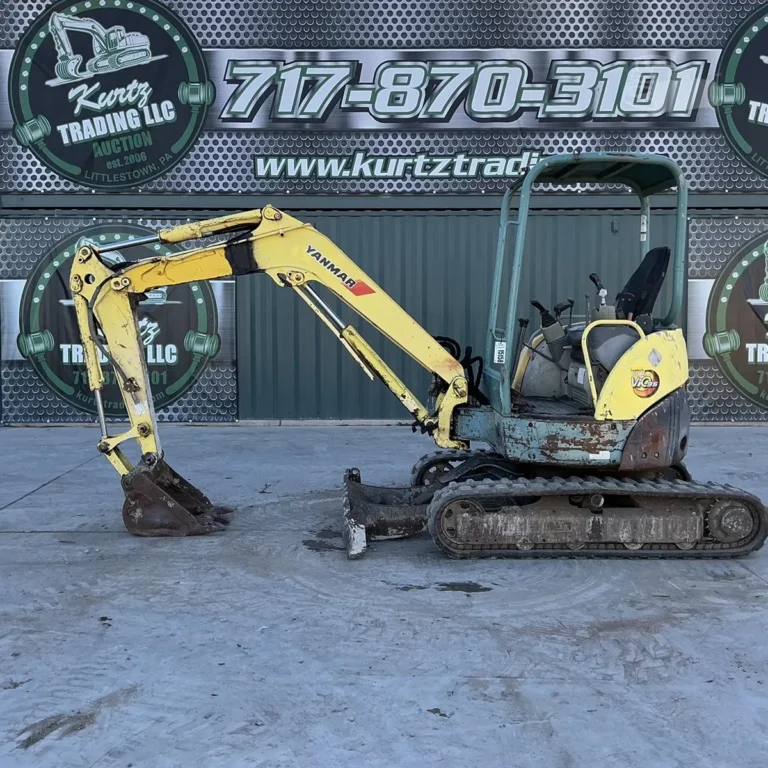
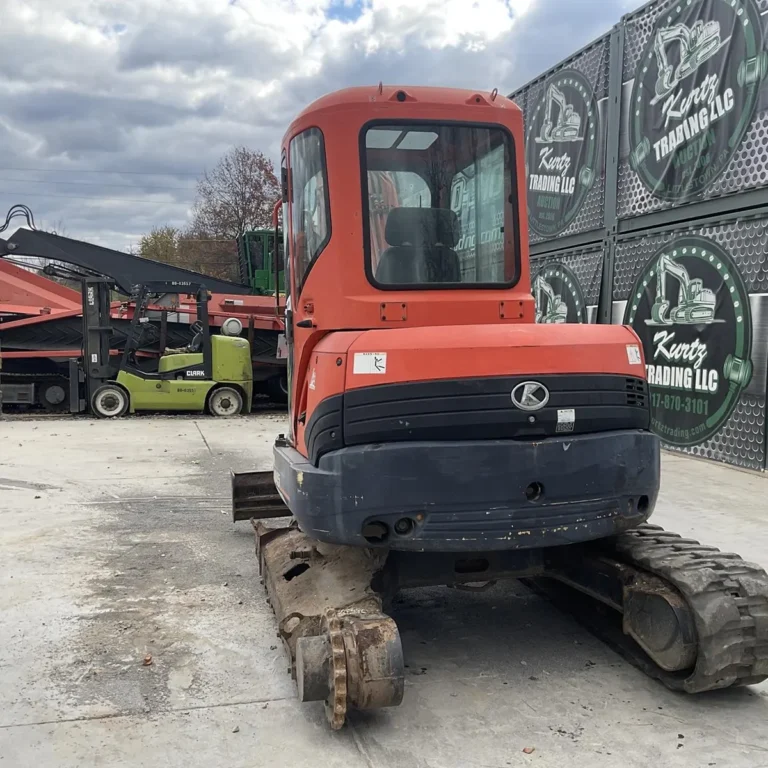
What this means if you are shopping in PA: a tight-tail mini is easy to find, especially from Cat and Deere. Browse the Cat mini excavators for sale for CR models and the John Deere mini excavators for sale for P-Tier ZTS and reduced machines. A true conventional mini takes more looking. For prices by size and brand, see our used mini excavator price guide.
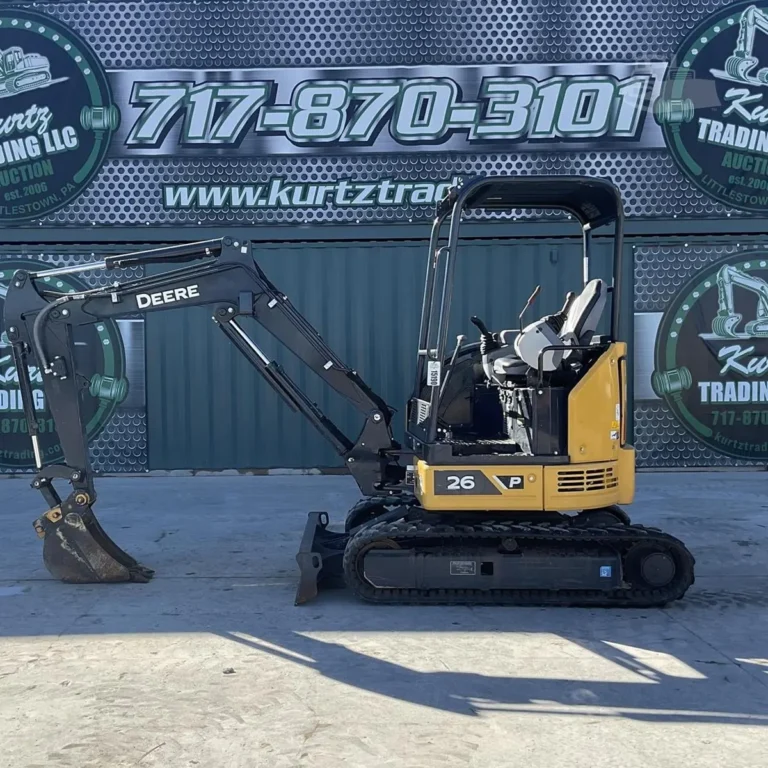
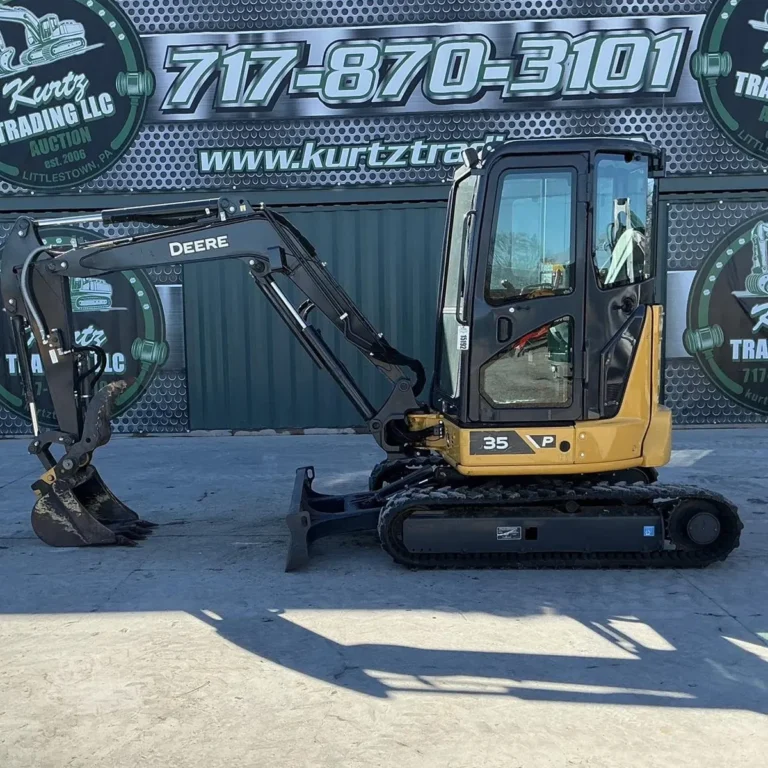
Find a zero tail swing mini excavator in Pennsylvania
Browse used mini excavators from PA dealers, check the model against the tables above, and ask the dealer for the tail swing radius before you buy.
Browse used mini excavators →Buying used: what tail swing changes in your inspection
Tail type changes what to look at on top of the usual items in our used excavator inspection checklist.
- ❌ Trusting “ZTS” in the listing title. ✅ Check the model on the maker’s spec sheet, then look for bolt-on extra counterweight, which can add 3 to 4 inches of overhang.
- ❌ Ignoring scrapes on the counterweight. ✅ Tight-tail machines live next to walls. Deep gouges or a repainted counterweight tell you it has been hitting things; check the rear corners of the house and the engine cover hinges too.
- ❌ Assuming a ZTS machine fits through your gate. ✅ Measure the track width. The ZTS twin is usually 6 to 8 inches wider than the conventional one.
- ❌ Planning heavy side lifts on a ZTS machine because the front chart looks good. ✅ Read the over-side column. On Deere’s 35 P-Tier it is 1,412 lb against 3,453 lb over the blade.
- ❌ Buying conventional for town work to save a little money. ✅ Count the repositioning and the risk: one damaged truck or wall can cost more than the price gap between twins.
- ❌ Forgetting the trailer. ✅ Width and weight go up on tight-tail twins; check our mini excavator weight guide before you hitch up.
The bottom line on zero tail swing vs conventional
Zero tail swing vs conventional comes down to what is behind you when you swing. Walls, traffic, fences and parked trucks: go zero or reduced, and accept a wider, slightly heavier machine. Open ground, narrow gates and heavy lifts off the side: conventional is still the better tool. Whatever the badge says, ask for two numbers before you buy: tail swing radius and undercarriage width. Half the width subtracted from the radius tells you how far the tail will reach past the tracks. In Pennsylvania’s used market, tight-tail minis are what you will mostly find, so if you want conventional, start looking early.
FAQ
What is a zero tail swing excavator?
An excavator whose upper house stays inside the width of its tracks through full rotation. Bobcat’s definition: “The rear of the house stays within the width of the tracks through full rotation.” You can swing next to a wall without the counterweight hitting it.
What is the difference between zero tail swing and reduced tail swing?
Zero tail swing keeps the tail inside the tracks. Reduced, minimal or short tail swing lets it hang a little past them. Bobcat puts minimal tail swing at up to 6 inches. On larger machines “reduced” can mean much more: Deere’s 85 P-Tier overhangs its tracks by about 19 inches.
What does CR mean on a Cat mini excavator?
CR stands for compact radius, Cat’s name for its tight-tail models such as the 303 CR and 308 CR. Check the exact tail swing radius on the machine you are buying, since a compact radius machine is not always zero tail swing.
Is a zero tail swing excavator less stable?
Over the side, it has less counterweight working for it, so compare the over-side column of the lift chart. Deere’s 35 P-Tier lifts 3,453 lb over the blade and 1,412 lb over the side at 10 feet, or 1,686 lb with the extra counterweight. The ZTS twins we compared are also wider than their conventional versions, which helps side stability.
Which is better for digging next to a house, ZTS or conventional?
Zero tail swing. You can dump to the side without the counterweight touching siding, forms or a fence. A conventional machine can do it, but the operator has to keep the tail clear on every swing or reposition more often.
Is the Bobcat E35 zero tail swing?
Yes. Bobcat lists the E35 with 0 inches of tail swing overhang with the standard arm, and 3.2 inches with the long-arm and extendable-arm versions. Its conventional twin is the E32, which overhangs 13.4 inches but is 7.9 inches narrower.