How much does a mini excavator weigh? On the manufacturers’ own sheets, the machines sold as mini or compact excavators run from about 2,300 lb for the smallest Kubota to more than 22,000 lb for a Cat 310 in its heaviest setup. Most models in the 1 to 6 ton classes weigh between about 3,500 and 13,000 lb. The exact number for the machine you are buying decides the trailer, the truck, how many chains you need and sometimes the license. This guide gives the official operating weight of John Deere, Cat, Bobcat, Kubota, Takeuchi and Yanmar mini excavators, the weight of every mini excavator Pennsylvania dealers have listed on Heavy Listing today, and the trailer math that goes with it.
Mini excavator weight chart: John Deere and Cat
This mini excavator weight chart uses only figures from the manufacturer’s own spec sheet or product page, linked under each table. Older models are included where we found an official sheet, because they are what you find for sale used. Where the sheet prints more than one weight (canopy or cab, rubber or steel tracks, standard or long arm), the range is shown.
| Model | Operating weight | Notes |
|---|---|---|
| John Deere 17G / 17 P-Tier | 3,790 lb | Standard arm, rubber track |
| John Deere 26G / 26 P-Tier | 5,780 / 6,110 lb | Canopy / cab |
| John Deere 30G / 30 P-Tier | 6,850 / 7,220 lb | Canopy / cab |
| John Deere 35G / 35 P-Tier | 7,760 / 8,135 lb | Canopy / cab; 8,340 / 8,715 lb with long arm and extra counterweight |
| John Deere 50G / 50 P-Tier | 10,560 / 10,847 lb | Canopy / cab; 11,063 / 11,349 lb with long arm and extra counterweight |
| John Deere 60G / 60 P-Tier | 13,250 to 13,910 lb | Canopy rubber track to cab steel track with long arm; includes a 450 lb bucket |
| John Deere 85 P-Tier | 19,238 to 20,296 lb | Rubber belt to rubber pads with angle blade; Deere does not title it a compact excavator |
| Cat 303 CR | 6,670 to 7,552 lb / 6,924 to 7,817 lb | Canopy / cab, minimum to maximum setup |
| Cat 303E CR | 7,297 / 7,782 lb | Canopy / cab; older E series |
| Cat 303.5 CR | 7,673 to 8,930 lb / 7,982 to 9,239 lb | Canopy / cab, minimum to maximum setup |
| Cat 305 CR | 11,016 to 12,469 lb / 11,234 to 12,688 lb | Canopy / cab, no bucket |
| Cat 308E2 CR | 18,519 lb | Cab, rubber tracks, with bucket |
| Cat 308 CR | 17,960 to 20,678 lb | Cab, no bucket; two Cat sheets disagree (see below) |
| Cat 310 | 21,166 to 22,447 lb | Cab, no bucket |
Sources: John Deere spec sheets for the 17G, 26G, 30G, 35G, 50G, 60G, the P-Tier sheets for the 26, 35, 60 and 85; Cat spec sheets for the 303 CR, 303E CR, 303.5 CR, 305 CR, 308E2 CR, 308 CR (one, two) and 310, as posted by Cat dealers (cat.com blocks automated access).
The P-Tier is Deere’s current name for the G-Series line, and for the 17, 26, 35, 50 and 60 the P-Tier sheet prints the same weights as the G sheet. A used 35G and a new 35 P-Tier land in the same row.
Bobcat, Kubota, Takeuchi and Yanmar mini excavator weights
| Model | Operating weight | Notes |
|---|---|---|
| Bobcat E10 / E10e | 2,593 / 2,648 lb | E10e is the electric version |
| Bobcat E17 / E20 | 3,774 / 4,167 lb | |
| Bobcat E26 / E32 | 6,489 / 7,403 lb | |
| Bobcat E35 | 7,659 lb | 8,362 lb long arm; 8,590 lb extendable arm |
| Bobcat E38 / E40 / E48 | 7,893 / 9,180 / 9,830 lb | |
| Bobcat E42 | 9,246 or 9,830 lb | Non-current; Bobcat’s page lists two versions |
| Bobcat E50 | 10,677 or 11,876 lb | Non-current; two versions listed |
| Bobcat E55 / E60 | 11,357 / 12,315 lb | |
| Bobcat E88 | 19,600 lb | 8 t class, conventional tail swing |
| Kubota K008-5 / U10-5 | 2,315 / 2,646 lb | Canopy, rubber tracks |
| Kubota U17-5 / KX018-4 | 3,702 / 3,747 lb | Canopy, rubber tracks |
| Kubota U27-4 / KX030-4 | 5,688 / 6,272 lb | Canopy, rubber tracks |
| Kubota KX033-4 / U35-4 | 7,420 / 8,129 lb | Canopy, rubber tracks |
| Kubota KX040-5 / U48-5 | 9,199 / 10,848 lb | Canopy, rubber tracks |
| Kubota U55-5 / KX057-5 | 12,247 / 12,346 lb | Canopy, rubber tracks |
| Kubota KX080-5 | 18,365 lb | Cab, rubber tracks |
| Takeuchi TB210R / TB216 | 2,535 / 3,900 lb | |
| Takeuchi TB225 / TB230 | 4,995 / 6,215 lb | |
| Takeuchi TB235-2 | 7,416 / 7,639 lb | Canopy / cab |
| Takeuchi TB240 | 8,575 / 8,995 lb | Canopy / cab |
| Takeuchi TB250-2 | 10,970 / 11,300 lb | Canopy / cab |
| Takeuchi TB260 | 12,160 / 12,675 lb | Canopy / cab |
| Takeuchi TB290 | 18,585 / 19,105 lb | Cab, rubber / steel tracks |
| Yanmar ViO17 | 4,023 lb | Rubber tracks |
| Yanmar ViO25 | 5,908 to 6,383 lb | Canopy rubber to cab steel |
| Yanmar ViO35-6A / ViO35-7 | 7,905 to 8,434 lb / 7,540 to 7,882 lb | Canopy to cab |
| Yanmar ViO50-6A / ViO55-6A | 10,417 to 11,078 lb / 11,850 to 12,313 lb | Canopy rubber to cab steel |
| Yanmar ViO80-7 | 18,409 / 18,453 lb | Cab, rubber / steel tracks |
Sources: Bobcat compact excavator lineup, E35, E88, non-current E42 and E50; Kubota 2026 construction product line brochure; Takeuchi TB240, TB260, TB290 and the other model pages on takeuchi-us.com; Yanmar Compact Equipment North America ViO17, ViO25, ViO35-6A, ViO35-7, ViO50-6A, ViO55-6A, ViO80-7.
Some gaps. We found no official sheet for the Kubota U45-3, the Cat 303.5E2 CR, the Cat 301.5 to 302.7 range or older Yanmar ViO35 generations, so they are not in the charts. Kubota’s 2026 brochure prints the canopy weight only (cab for the KX080-5), so add a few hundred pounds for a cab Kubota. If you are still choosing a size class rather than a model, our mini excavator sizes guide groups these machines by ton class and dig depth.
How heavy are the mini excavators for sale in Pennsylvania?
On November 23, 2026, Pennsylvania dealers had 16 mini excavators listed on Heavy Listing, in Littlestown, Waterford, Dunmore, Williamsport and Carbondale. Here is every one, with the weight from the manufacturer’s sheet for that model:
| Machine listed | Sheet weight | 10,000 lb or more? |
|---|---|---|
| John Deere 26G (2016, 2023) | 5,780 / 6,110 lb | No |
| John Deere 26 P-Tier with cab (2023) | 6,110 lb | No |
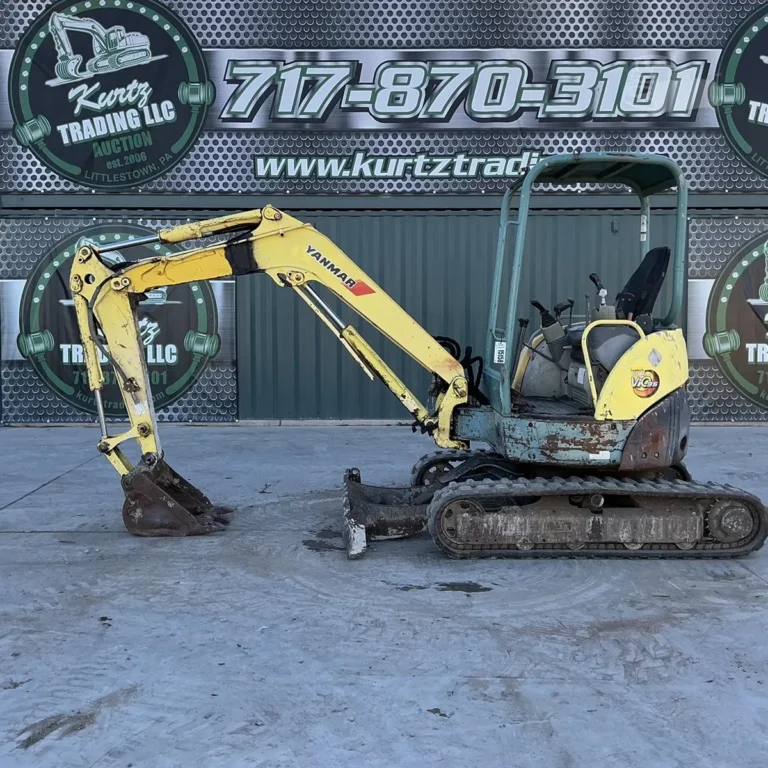
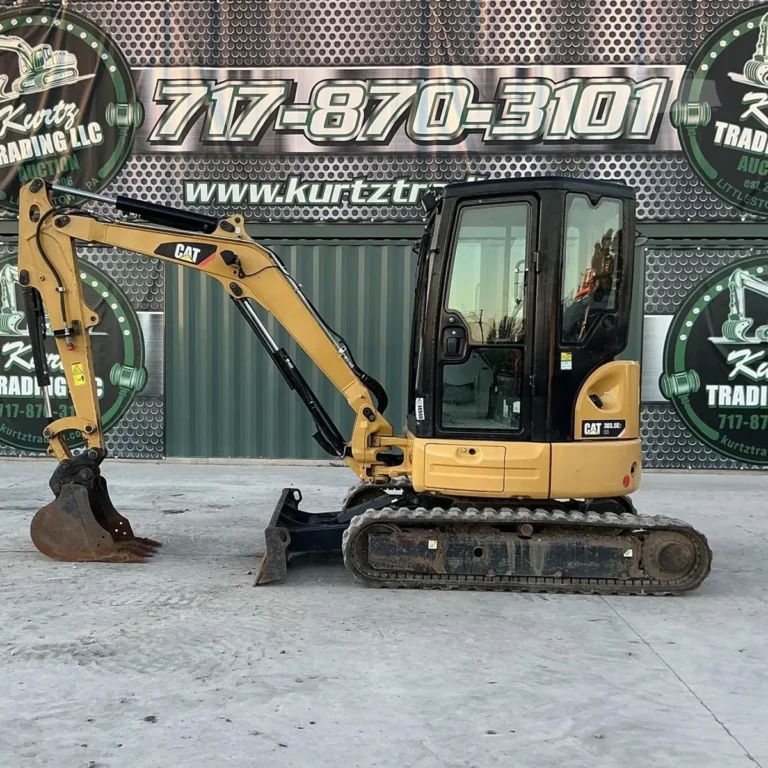
| Cat 303 CR with cab (2022) | 6,924 to 7,817 lb | No |
| John Deere 35 P-Tier (two, 2024) | 7,760 / 8,135 lb | No |
| Takeuchi TB240 (2016) | 8,575 / 8,995 lb | No |
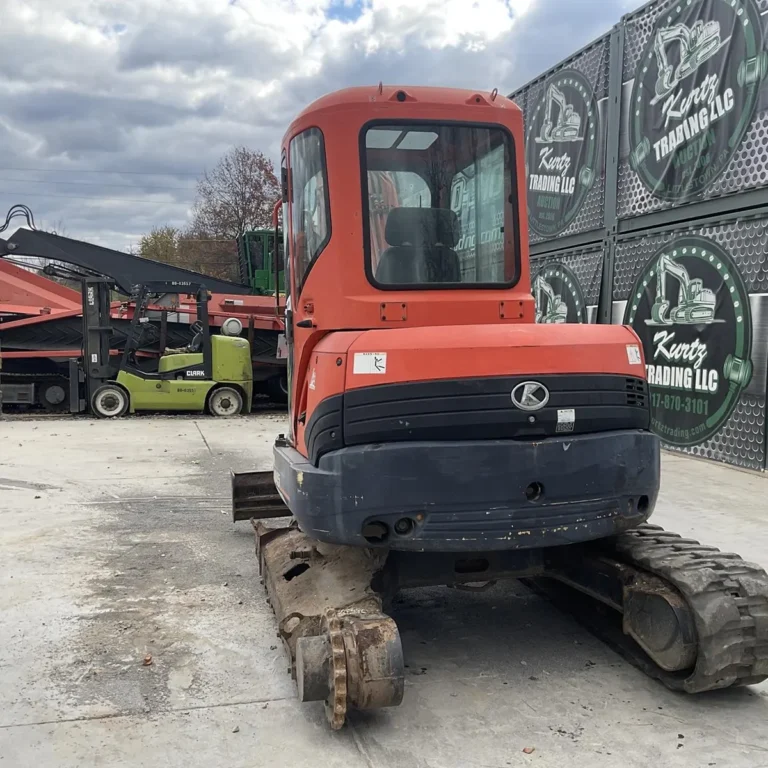
| Bobcat E42 with cab (2020) | 9,246 or 9,830 lb | No |
| John Deere 60G (2023) | 13,250 to 13,910 lb | Yes |
| Cat 308E2 CR with cab (2019) | 18,519 lb | Yes |
| Cat 308 CR (2021) | 17,960 to 20,678 lb | Yes |
| John Deere 85 P-Tier (2023) | 19,238 to 20,296 lb | Yes |
| Cat 310 with cab (2019) | 21,166 to 22,447 lb | Yes |
| Yanmar ViO35 (2005), Kubota U45-3 (2006), Cat 303.5E2 CR (2019) | No official sheet found | Ask the dealer |
Source: Heavy Listing listings from Pennsylvania dealers, November 23, 2026; weights from the manufacturer sheets cited above.
So 5 of the 16 weigh 10,000 lb or more on their own sheet, and those five are a different hauling job from the rest. At the light end, a 2016 Deere 26G with 2,035 hours at $24,500 is a 5,780 lb machine in its canopy form, the kind of load a heavy-duty pickup and a properly rated tag trailer can handle. In the middle, a 2022 Cat 303 CR with a cab at $37,500 sits under 8,000 lb even in its heaviest setup. At the heavy end, a 2019 Cat 310 at $69,500 and a 2023 John Deere 85 P-Tier at $99,400 weigh about as much as two or three 35-class machines. Seven of the 16 are John Deere; browse them on the John Deere mini excavators for sale page, or the five Cat mini excavators for sale. For what each one costs by size and age, see our used mini excavator prices.
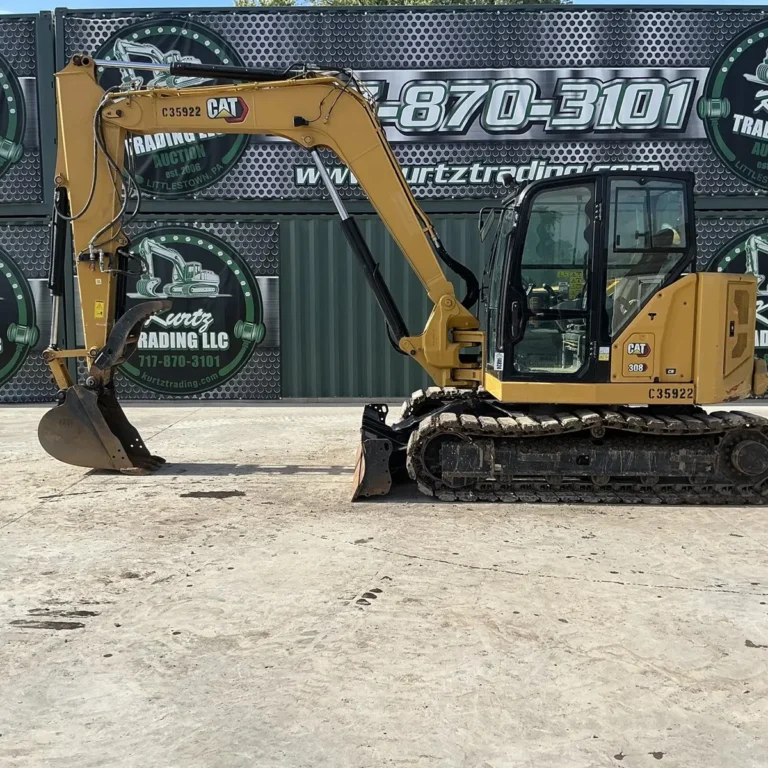
Operating weight vs shipping weight: what each sheet counts
Operating weight is not the bare machine, and each brand counts different things. A few hundred pounds between two sheets can be the operator, the bucket or the cab rather than the steel.
| Brand | Operator | Fuel | Bucket and setup |
|---|---|---|---|
| John Deere 17G, 26G, 35G, 50G | 175 lb | Full tank | Standard arm and counterweight; bucket not stated |
| John Deere 30G | 165 lb | Full tank | “Standard front attachments”, 723 lb counterweight |
| John Deere 60G | 165 lb | Full tank | 30 in, 450 lb bucket and 1,642 lb counterweight included |
| Cat 303 CR, 303.5 CR | Included | Full tank | Blade and bucket included |
| Cat 305 CR, 308 CR, 310 | Included | Full tank | Blade included, no bucket |
| Kubota (2026 brochure) | Not stated | Not stated | Canopy, rubber tracks |
| Bobcat, Takeuchi, Yanmar | No breakdown on the model pages | ||
Sources: footnotes on the Deere, Cat and Kubota sheets linked above. Bobcat’s pages note that some figures are “based on engineering calculations and are not actual measurements.”
Shipping weight is the machine as it rides on the trailer, which in practice means without the operator. None of the mini excavator sheets we opened prints a separate shipping weight. Cat’s 303 CR and 303.5 CR sheets print a third number, the EU “CE plate weight”: the most common European setup with a 165 lb operator and full fuel, without a bucket (7,012 lb for a 303 CR with cab). It is not a US shipping weight.
For the trailer, use operating weight, then add whatever the sheet left out. On a Cat 308 CR or 310 that means adding the bucket. On a Deere 35G, the sheet does not say, so ask the seller what bucket is on it and add it. The operator you take out is 165 to 175 lb; a spare bucket or a hydraulic thumb on the deck is usually more.
Cab vs canopy, steel tracks, counterweight: what adds weight
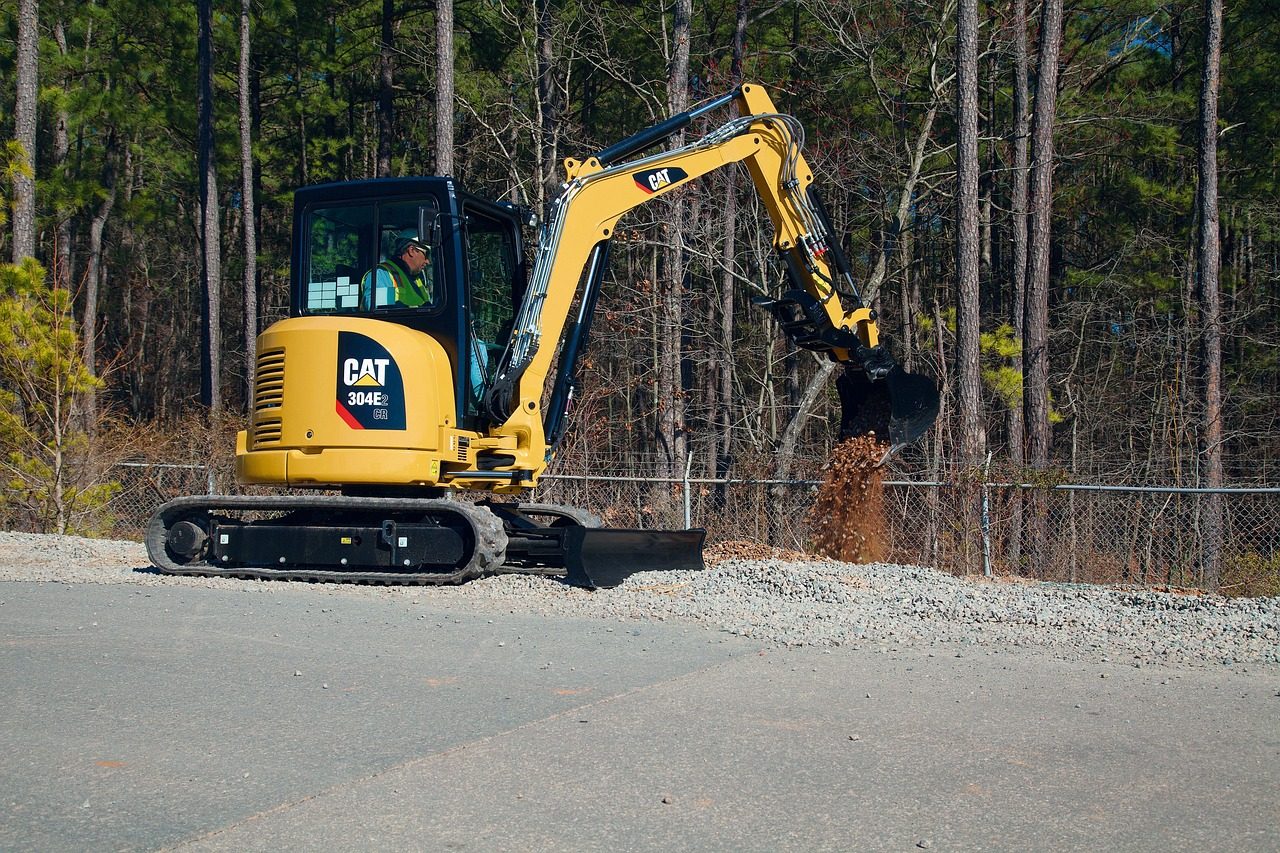
Two mini excavators of the same model can differ by 1,000 lb or more on the trailer. The sheets show where it comes from:
| Option | Weight it adds | Example from the sheet |
|---|---|---|
| Enclosed cab instead of canopy | About 220 to 520 lb | Takeuchi TB235-2 +223 lb; Cat 303 CR +254 lb; Deere 35G +375 lb; Takeuchi TB240 +420 lb; Takeuchi TB260 +515 lb |
| Steel tracks instead of rubber | About 220 to 830 lb | Deere 60G +220 lb; Cat 303 CR +276 lb; Cat 308 CR +752 lb (steel with pads); Cat 305 CR +827 lb (steel with pads) |
| Extra counterweight | About 440 to 600 lb | Deere 50G +441 lb; Deere 35G +529 lb; Cat 305 CR +534 lb; Cat 303 CR +551 lb; Cat 308 CR and 310 +552 lb; Deere 60G +595 lb |
| Long arm or stick | About 55 to 150 lb | Cat 303 CR +55 lb; Cat 305 CR +75 lb; Cat 308 CR +146 lb |
| Angle blade (Deere option) | 653 to 1,010 lb listed | Deere 35G 653 lb; 50G 902 lb; 60G 1,010 lb |
Sources: “weight increase from minimum configuration” tables on the Cat sheets; Deere, Takeuchi and Yanmar canopy and cab figures linked above. Differences are our own arithmetic where the sheet gives two totals. Deere prints the angle blade as a weight line, not as a net increase over the standard blade.
Stack them and it adds up. Cat’s own 303 CR sheet goes from 6,670 lb (canopy, rubber tracks, standard stick, no extra counterweight) to 7,817 lb (cab, steel tracks, long stick, extra counterweight): 1,147 lb more for the same model. Deere’s 35G goes from 7,760 lb as a canopy machine to 8,715 lb with a cab, long arm and extra counterweight. Before you pick a row in the chart, check the listing or the machine for cab, track type and counterweight. Whether the tail swings over the tracks is a separate question; our zero tail swing vs conventional excavator guide covers what that changes.
When the manufacturer prints two different numbers
It happens, and the answer is to plan for the higher one.
- Cat 308 CR: one Cat sheet lists 18,610 lb minimum and 20,077 lb maximum with cab. Another 308 CR sheet, uploaded to a Cat dealer’s site in January 2021, lists 17,960 and 20,678 lb, on the same basis (no bucket). Same model name, a 600 lb gap at the top end.
- Cat 310: two copies of the sheet print 21,166 / 22,447 lb and 21,170 / 22,451 lb. Four pounds will not change your trailer, but it shows that the weight of a model is a sheet figure, not a scale reading.
- Bobcat E42 and E50: Bobcat’s page for each non-current model shows two versions under the same name: 9,246 or 9,830 lb for the E42, and 10,677 or 11,876 lb for the E50. The serial number tells you which one you have.
- Yanmar ViO35: the ViO35-6A (7,905 lb canopy) and the newer ViO35-7 (7,540 lb canopy) are different machines with the same family name. A listing that just says “ViO35” needs a closer look.
If you are buying a specific machine and the margin on the trailer is thin, the most reliable figure is a ticket from a certified truck scale with the machine and its buckets on the trailer.
Where “mini” ends: 8 ton machines on the trailer
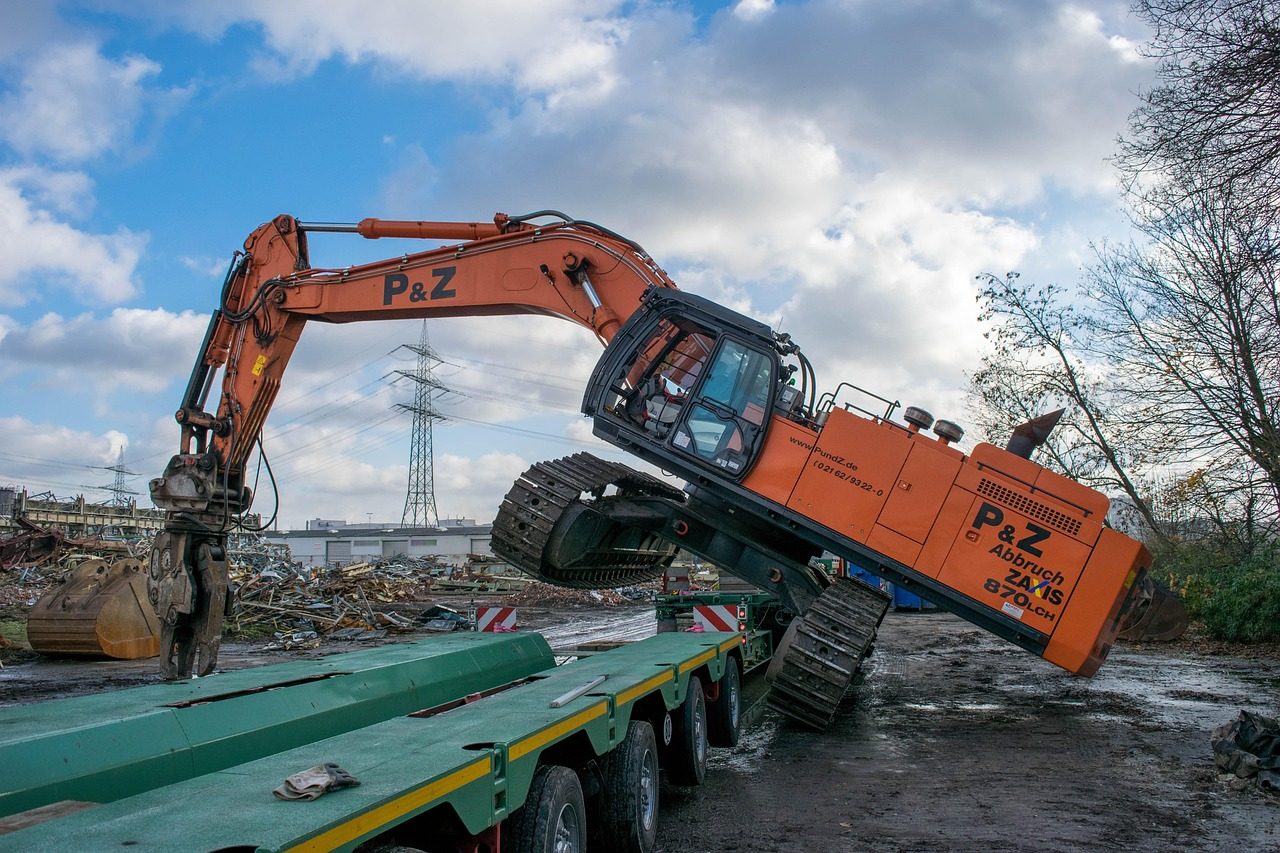
“Mini excavator” has no legal weight limit, and listings use it loosely. Dealers list the John Deere 85 P-Tier as a mini excavator, while Deere’s own spec sheet titles it “85 P-Tier Excavator”, not “compact excavator” like the 17 to 60 sheets. Bobcat lists the E88 (19,600 lb) as a compact excavator in the 8 t class. Kubota’s KX080-5 is 18,365 lb with a cab, and Takeuchi’s TB290 is 18,585 lb.
Those machines weigh roughly two and a half times a 35-class mini. A 35G at 8,135 lb with a cab and a Deere 85 P-Tier at 19,445 lb (steel shoes with rubber pads, no blade) share a category on many sites and nothing on the trailer. If your search started with “mini” because you wanted to tow it yourself, check the model number before you check the price. For machines above that class, our full-size excavators for sale are a separate category.
What trailer and truck do you need for a mini excavator?
The number that counts on the trailer is its GVWR (gross vehicle weight rating), on the VIN plate. GVWR includes the trailer itself, so:
Payload = trailer GVWR − trailer empty weight
A hypothetical example: a tag trailer rated at 10,000 lb GVWR that weighs 2,500 lb empty can carry 7,500 lb. That covers a Deere 26G with a cab (6,110 lb) with some room left for a spare bucket. It does not cover a Deere 35G with a cab (8,135 lb), even though “3.5 ton” sounds like it should fit.
❌ Wrong: “It’s a 3.5 ton mini excavator and my trailer is rated 10,000 lb, so I have room to spare.”
✅ Right: “The 35G with cab is 8,135 lb on Deere’s sheet. My trailer weighs 2,500 lb empty, so its payload is 7,500 lb. I need a higher-rated trailer.”
The ton number in the model name is metric. “3.5 ton” means about 7,700 lb, not the 7,000 lb a US ton would suggest, and that is before the cab.
Then check the truck: its towing rating, hitch rating and GCWR (gross combination weight rating), on the door sticker or in the owner’s manual, must cover the loaded trailer. Our guide to transporting heavy equipment in Pennsylvania puts mini excavators on bumper-pull or gooseneck trailers behind a heavy-duty pickup, and compares tag, gooseneck, tilt and lowboy trailers and what a hauler charges. A useful split from the charts above:
- Under about 6,500 lb (Deere 17G to 26G, Bobcat E10 to E26, Kubota up to U27-4, Takeuchi up to TB230): a tag trailer rated for the load, behind a pickup rated to tow it.
- About 7,000 to 13,000 lb (30 to 60 class): the trailer usually needs a GVWR over 10,000 lb, which is where the license question below starts.
- About 18,000 lb and up (308, 310, 85 P-Tier, E88, KX080-5, TB290, ViO80): heavy gooseneck within its rating, or a semi and lowboy.
Tie-downs and CDL rules for hauling a mini excavator
Two federal thresholds fall inside the mini excavator weight range:
- Four tie-downs at 10,000 lb. Under 49 CFR 393.130, machinery on wheels or tracks that weighs 10,000 lb or more must be restrained with at least four tie-downs, and accessory equipment like the bucket must be lowered and secured. From the charts, that covers the Deere 50G, 60G and 85 P-Tier, the Cat 305 CR, 308 CR, 308E2 CR and 310, the Bobcat E50, E55, E60 and E88, the Kubota U48-5, U55-5, KX057-5 and KX080-5, the Takeuchi TB250-2, TB260 and TB290, and the Yanmar ViO50-6A, ViO55-6A and ViO80-7. The rule allows lighter machines to be secured the same way.
- Class A CDL at 26,001 lb combined. Under 49 CFR 383.91, a combination with a gross combination weight rating (or actual weight, whichever is greater) of 26,001 lb or more, towing a trailer rated over 10,000 lb, needs a Class A CDL when used in commerce.
Mini excavator owners usually hit the second line through the trailer, not the machine. A Deere 35G with a cab (8,135 lb) on a trailer that weighs 2,500 lb empty is about 10,600 lb on the axles, so the trailer needs a GVWR over 10,000 lb. Behind a truck with a GCWR of 26,001 lb or more, that is a Class A combination for business use, even though the excavator alone is a “small” machine. A 26G on a trailer rated 10,000 lb or less stays out of that rule, if the trailer’s payload covers it. Check the truck’s GCWR and the trailer’s GVWR before you buy, not after. If you think a farm or other exemption applies, or the trip crosses state lines, confirm it before you go; the transport guide covers the 10,001 lb federal commercial vehicle line too.
Width is rarely the problem on a mini: Bobcat lists the E35 at 69.7 in and the E88 at 86.6 in, and Kubota’s KX080-5 is 7 ft 2.6 in wide, all under Pennsylvania’s 8 ft 6 in legal width. Height on the trailer is worth a check on the larger ones: add the deck height to the machine’s transport height and keep it under 13 ft 6 in.
How to find the weight of a specific used mini excavator
- Get the exact model and series from the serial plate, then note the setup. 303E CR and 303 CR, ViO35-6A and ViO35-7, 308E2 CR and 308 CR are different numbers, and cab, steel tracks, long arm and extra counterweight each move it again.
- Find the manufacturer’s sheet for that series and read the footnote. Note whether the bucket and operator are in the figure. The operator’s manual usually lists it too.
- Add what will ride on the trailer: buckets, thumb, breaker, chains and binders, fuel cans.
- If the margin is thin, weigh it. A certified scale ticket ends the argument.
While the machine is in front of you, our used excavator inspection checklist covers what to check besides the weight, from swing bearing play to track wear and hours.
The bottom line
Mini excavator weight runs from 2,300 to 13,000 lb for most models, and the 8 ton machines sold under the same name run 18,000 to 22,000 lb. The number that matters is the one for the exact series and setup, plus whatever rides with it. Of the 16 mini excavators Pennsylvania dealers have listed today, 5 weigh 10,000 lb or more on their own, and several of the rest still push the trailer past a 10,000 lb rating once you add the trailer itself. Take the figure from the manufacturer’s sheet, use the cab, steel-track and counterweight figure when it applies, add the bucket if the sheet left it out, and compare the total with the trailer’s payload and the truck’s GCWR.
Looking for a mini excavator you can haul?
Browse the mini excavators Pennsylvania dealers have listed right now, with year, hours, price and location on every listing. Check the model against the weight charts above before you hook up the trailer.
Browse mini excavators →FAQ
How much does a 3.5 ton mini excavator weigh?
About 7,400 to 9,200 lb on the manufacturers’ sheets. John Deere lists the 35G at 7,760 lb with a canopy and 8,135 lb with a cab, Bobcat lists the E35 at 7,659 lb, Kubota the U35-4 at 8,129 lb with a canopy, and Cat the 303.5 CR at 7,673 to 9,239 lb depending on setup.
How much does a John Deere 35G weigh?
Deere’s spec sheet lists the 35G at 7,760 lb with a canopy and 8,135 lb with a cab, with a full fuel tank and a 175 lb operator. With the long arm and extra counterweight it is 8,340 lb (canopy) or 8,715 lb (cab). The 35 P-Tier sheet prints the same figures.
How much does a Cat 308 mini excavator weigh?
Cat’s 308 CR sheets list about 18,000 to 20,700 lb with a cab, without a bucket, depending on tracks, stick and counterweight; two editions of the sheet disagree by a few hundred pounds. The older 308E2 CR is listed at 18,519 lb with a cab, rubber tracks and bucket.
How much does a Bobcat E35 weigh?
Bobcat lists the E35 at 7,659 lb, 8,362 lb with the long arm and 8,590 lb with the extendable arm. It is 69.7 in wide.
Can I tow a mini excavator with a pickup?
Small ones, yes, if the truck, hitch and trailer are rated for the load. A 26-class machine at about 6,000 lb fits on a properly rated tag trailer. A 35-class machine at about 8,000 lb usually needs a trailer rated over 10,000 lb, and with a truck rated at 26,001 lb combined or more that combination needs a Class A CDL for business use under 49 CFR 383.91.
What is the difference between operating weight and shipping weight?
Operating weight is the machine ready to work: fuel, fluids and usually an operator, and on some sheets a bucket. Shipping weight is what rides on the trailer, without the operator. Few mini excavator sheets print a shipping weight, so plan on the operating weight and add any bucket or attachment the sheet did not include.