Most used machines on a Pennsylvania lot are not bought with a check for the full price. A contractor puts some money down and finances the rest, or leases, or uses an SBA-backed loan from the bank they already use. Used heavy equipment financing is not hard, but the offers look alike on paper and cost very different amounts over three to five years. This guide covers the main ways to finance used equipment, what lenders check, how to finance an auction purchase without missing the payment deadline, a worked payment example, and what the IRS says about Section 179 and bonus depreciation on used equipment for 2026.
Your options for financing used equipment
There are five common routes. Most buyers get quotes from two or three of them for the same machine.
1. Equipment loan from a bank or credit union
The simplest structure: you buy the machine, the lender takes a lien on it, and you pay it off in fixed monthly payments. If you already have a business checking account and a history with a local bank, start there.
2. Manufacturer (captive) finance on used machines
The big brands have their own finance companies, and some of them also finance used units, often through their dealers and sometimes with conditions on the age of the machine. Promotional rates are usually aimed at new equipment, so do not assume a low rate you saw advertised applies to a used one. Ask the dealer what the captive lender offers on that specific machine.
3. Dealer-arranged financing
Many used equipment dealers work with one or more outside lenders and can submit your application for you. It is convenient, and the dealer knows which lenders take older machines. The trade-off is that you see the offer the dealer brings, not the whole market. Get one quote on your own so you have something to compare.
4. Equipment lease
A lease lets you use the machine for a fixed term with monthly payments. What happens at the end decides what kind of lease it really is (see the table below).
5. SBA 7(a) loan
The U.S. Small Business Administration guarantees part of loans made by approved lenders. According to SBA.gov, the 7(a) program can be used for “purchasing and installation of machinery and equipment,” and the maximum 7(a) loan amount is $5 million. The SBA’s terms and conditions page for lenders says the maturity is generally “ten years or less, unless it finances or refinances real estate or equipment with a useful life exceeding ten years,” and caps variable rates at a base rate plus a spread that depends on loan size (base rate plus 6.5% for loans of $50,000 or less, down to base rate plus 3.0% above $350,000). SBA loans take more paperwork and more time. Our take: they make sense for a planned purchase or a fleet expansion, not for a machine you need on a job next week.
Loan vs. $1 buyout lease vs. FMV lease
These three get confused more than anything else in equipment finance. Here is how they differ in practice:
| Equipment loan | $1 buyout lease | FMV (fair market value) lease | |
|---|---|---|---|
| Who owns it during the term | You, with a lien | The lessor on paper | The lessor |
| End of term | Lien released, machine is yours | Pay $1, machine is yours | Return it, renew, or buy it at fair market value |
| Monthly payment | Pays off the full price | Similar to a loan | Usually lower, since you do not pay off the full value |
| Best for | Machines you will keep for years | Same, when the lessor offers better terms than a lender | Machines you want to replace at the end of the term |
| Depreciation and Section 179 | You own it, so you depreciate it | Often treated as a purchase for tax purposes; ask your accountant | Generally the lessor’s, not yours |
That last row matters. IRS Publication 946 says that “if you lease property from someone to use in your trade or business,” you generally “cannot depreciate its cost because you do not retain the incidents of ownership.” Whether a particular $1 buyout contract counts as a lease or a purchase for taxes depends on the contract, which is exactly the question to bring to your accountant before you sign.
What lenders look at before they say yes
Every lender has its own rules, but the same questions come up in almost every application:
- Time in business: an established business with a few years of tax returns is an easier file than a startup. New businesses can still get financed, but expect a bigger down payment or a personal guarantee.
- Credit: your business credit and, for most small companies, the owner’s personal credit.
- Down payment: more money down lowers the lender’s risk and your payment. Some lenders also accept a trade-in as part of the down payment.
- Age and hours of the machine: lenders worry about what the machine will be worth if they have to repossess it. An older or high-hour unit can mean a shorter term or a larger down payment. Our study of how many hours is a lot on heavy equipment shows what normal looks like by machine type.
- Collateral and paperwork: the machine is normally the collateral. Have the serial number, year, hours, a seller’s invoice or bill of sale and photos ready. Lenders move faster when the file is complete.
Financing an auction purchase: get approved before the sale
Auctions are where financing goes wrong most often. Auctioneers expect payment within days, not weeks. In our guide on how to buy at an equipment auction, the published terms of two Pennsylvania auctioneers set payment due within 3 business days, and the first Tuesday after the sale. A loan that is still in underwriting is not an excuse they accept.
- Get pre-approved for an amount, not a machine. Ask your lender for a pre-approval up to a set dollar figure, and confirm whether it covers auction purchases and any age limit on the machine.
- Set your maximum bid from the full cost. The hammer price is not what you pay. Add the buyer’s premium and any online fee, then sales tax. Our guide to buyer’s premiums at equipment auctions shows the math. Your pre-approval has to cover the total.
- Confirm how the lender pays. Wire, check to the auctioneer, or funds to you. Make sure it fits the auctioneer’s accepted payment methods and deadline.
- Have the down payment in your account before sale day, plus the money for transport.
Upcoming sales are on our auction calendar, so you can start the paperwork early.
A worked payment example (hypothetical)
Here is how the math works. These numbers are made up to show the formula. They are not quotes and not rates any lender is offering you. Your rate depends on your credit, the machine and the lender.
Say you buy a used excavator for $75,000, put $15,000 down (20%) and finance $60,000. The monthly payment on a standard loan is:
Payment = P × r ÷ (1 − (1 + r)−n)
- P = amount financed ($60,000)
- r = annual rate ÷ 12
- n = number of monthly payments
At a hypothetical 9% over 60 months, r = 0.09 ÷ 12 = 0.0075, and the payment comes to about $1,246 a month. Here is the same $60,000 at a few hypothetical rates:
| Hypothetical rate | 36 months | 48 months | 60 months | Total interest over 60 months |
|---|---|---|---|---|
| 7% | $1,853 | $1,437 | $1,188 | $11,284 |
| 9% | $1,908 | $1,493 | $1,246 | $14,730 |
| 11% | $1,964 | $1,551 | $1,305 | $18,273 |
| 13% | $2,022 | $1,610 | $1,365 | $21,911 |
Illustrative only. Payments rounded to the dollar, assuming fixed monthly payments and no fees. Not an offer or quote.
Two things jump out. Going from 7% to 13% on a five-year loan costs about $10,600 more in interest on this machine. And stretching from 36 to 60 months lowers the payment by roughly $650 a month at every rate, but adds thousands in interest. Pick the term that fits how long the machine will actually earn for you.
Not sure what a fair price is in the first place? Check our used excavator prices and used skid steer prices, built from real Pennsylvania dealer listings. Financing a machine that was overpriced to begin with is the most expensive mistake on this page.
Section 179 and bonus depreciation on used equipment in 2026
This is where buying used equipment can pay off at tax time. What follows is what the IRS publishes, not tax advice. Talk to your accountant before you buy for tax reasons.
Section 179 limits for 2026
IRS Revenue Procedure 2025-32 sets the 2026 figures. For taxable years beginning in 2026:
| Section 179 item (tax years beginning in 2026) | Amount |
|---|---|
| Maximum Section 179 deduction | $2,560,000 |
| Phase-out begins when total Section 179 property placed in service exceeds | $4,090,000 |
Source: IRS Rev. Proc. 2025-32, section 4.24. For comparison, IRS Publication 946 gives $2,500,000 and $4,000,000 for tax years beginning in 2025.
The deduction is reduced dollar for dollar by the amount you go over the phase-out threshold. Publication 946 adds a business income limit: the deduction cannot exceed the taxable income from the active conduct of your trade or business for the year, and any amount you cannot deduct because of that limit carries to the next year.
Does used equipment qualify?
Yes, with conditions. Publication 946 says Section 179 property must be eligible property, acquired for business use, and “acquired by purchase.” It lists situations that are not a purchase, including buying from a related person (for this rule, your spouse, ancestors and lineal descendants, among others) and property received as a gift or inheritance. The plain-English version you will hear is that the machine has to be “new to you”: bought from an unrelated seller, not something you already used. That is a summary, not the IRS’s wording, so confirm your situation.
Business use counts too. Publication 946 says you can take the Section 179 deduction only if you use the property more than 50% for business in the year you place it in service, and then only on the business-use share of its cost.
Financing does not disqualify you
Publication 946 states: “You are considered as owning property even if it is subject to a debt.” A machine you buy with an equipment loan is yours for depreciation purposes. A true lease is different, as covered in the table above.
Bonus depreciation changed in 2025
Legislation passed in 2025, Public Law 119-21, which Publication 946 notes is “commonly known as the One Big Beautiful Bill Act,” changed bonus depreciation (the IRS calls it the special depreciation allowance). Publication 946 (2025) says: “Unless you elect out, you must take a 100% special depreciation allowance for certain qualified property… acquired and placed in service after January 19, 2025.” It also says qualified property “can be either new property or certain used property.”
Property acquired before January 20, 2025 follows the older phase-down rules: Publication 946 gives a 40% allowance for qualified property acquired after September 27, 2017, and before January 20, 2025, and placed in service in 2025. The acquisition date matters, so keep the purchase contract and invoice.
Pennsylvania sales tax on a financed purchase
Financing changes how you pay, not whether the sale is taxable. Pennsylvania sales tax is figured on the purchase price, and you need to know whether your lender will finance it or whether it comes out of your pocket at closing. Ask before you sign, because on a $75,000 machine the state’s 6% rate alone is $4,500.
Some purchases are exempt, farm use being the best-known case, and private sales and auctions have their own rules. Our guide to PA sales tax on heavy equipment walks through each one with links to the Pennsylvania Department of Revenue.
Red flags in equipment financing offers
Signs to slow down:
- ❌ Only the monthly payment is quoted. Ask for the rate, the term, the total of all payments and every fee in writing.
- ❌ Upfront fees before approval. An “application” or “processing” fee demanded by wire before you see terms is a warning sign.
- ❌ Guaranteed approval regardless of credit. Real lenders check credit and the machine.
- ❌ An unclear end-of-lease clause. “Fair market value” decided by the lessor alone can turn a cheap lease into an expensive buyout.
- ❌ Prepayment penalties you were not told about. If you might pay the machine off early after a good season, ask.
- ✅ A good offer shows the rate, term, total cost, fees, prepayment terms and, for a lease, exactly how the buyout is set.
Example:
❌ Wrong: “The payment is only $1,188 a month, let’s sign.”
✅ Right: “At $1,188 for 60 months, the total is about $71,300 on $60,000 borrowed. What is the rate, are there fees on top, and can I pay it off early without a penalty?”
A simple plan to finance your next machine
- Pick the machine at a fair price and inspect it before any money moves. Our price guides and used excavator inspection checklist help with both.
- Get two or three quotes: your bank or credit union, the dealer’s lender, and an SBA lender if the amount and timing fit.
- Compare the total cost, not the payment, at the same term.
- Talk to your accountant about loan vs. lease, Section 179 and bonus depreciation, before you sign.
Find the machine first, then finance it
Browse used equipment from Pennsylvania dealers with the price shown on every listing, so you know what you are asking a lender for. Contact the dealer directly, with no buyer’s premium on top.
Browse used equipment →Used excavators for sale from PA dealers
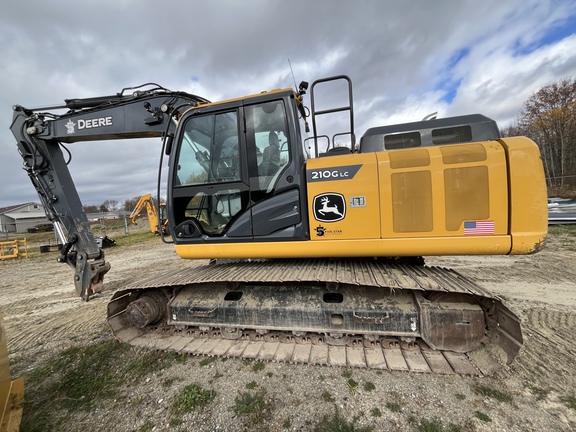
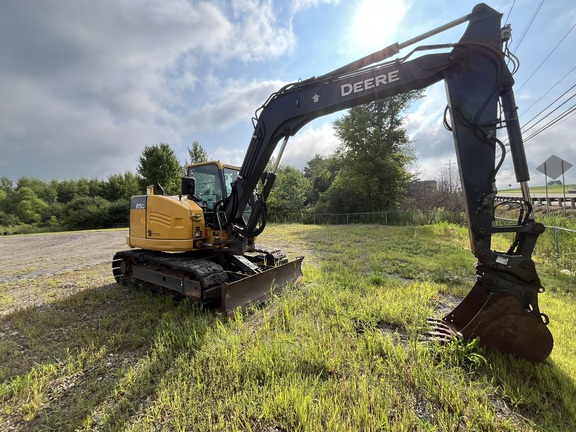
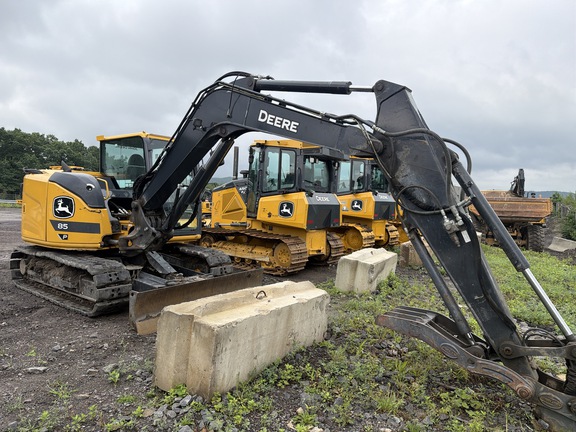
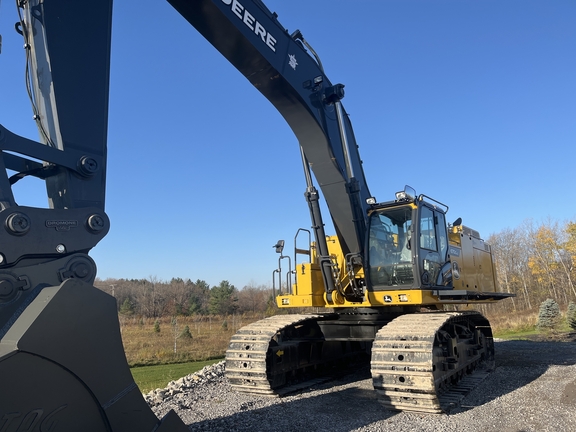
If you are pricing a machine for a loan application, these are some of the newest excavator listings on Heavy Listing:
Frequently asked questions
Can you finance used heavy equipment?
Yes. Banks, credit unions, manufacturer finance companies, dealer-arranged lenders and SBA 7(a) lenders all finance used machines. Older or high-hour units may come with a shorter term or a bigger down payment.
Does used equipment qualify for Section 179?
It can. IRS Publication 946 requires the property to be acquired by purchase for business use, and it excludes purchases from related persons and property received by gift or inheritance. For tax years beginning in 2026, the IRS sets the maximum Section 179 deduction at $2,560,000 (Rev. Proc. 2025-32). Ask your accountant how it applies to you.
Can I take Section 179 on financed equipment?
Generally yes. Publication 946 says you are considered as owning property even if it is subject to a debt. A true lease is different: the lessor usually owns the machine.
Is bonus depreciation 100% in 2026?
IRS Publication 946 (2025) says that unless you elect out, you must take a 100% special depreciation allowance for certain qualified property acquired and placed in service after January 19, 2025, and that qualified property can be new or certain used property. Check IRS.gov/Pub946 for later updates and confirm with your accountant.
How do I finance a machine I buy at auction?
Get pre-approved before the sale, for an amount that covers the hammer price, buyer’s premium, fees and sales tax. Payment is usually due within days, so the loan cannot still be in process after the auction.
Is it better to lease or buy used equipment?
If you will keep the machine for years, a loan or $1 buyout lease usually costs less overall. An FMV lease can make sense when you plan to replace the machine at the end of the term. Compare total cost and talk to your accountant about the tax side.